John Baddeley (father)

Ralph & John Baddeley (brothers - sons of John Baddeley)

John & Edward Baddeley (brothers - sons of John Baddeley)


Location and period of operation:

John Baddeley

Shelton

1750

1772

Ralph & John Baddeley

Shelton

1772

1780s

Ralph Baddeley

Shelton

1780s

1795

John & Edward Baddeley

Shelton

1784

1806


Family of porcelain and earthenware manufacturers at the Broad Street Works, Shelton, Stoke-on-Trent, England.


The various ‘Baddeley’ firms represent a continuous family manufactory at Shelton, rather than separate unrelated partnerships.


Dates are approximate and are estimated mainly from four sources:

Shaw, Simon - History of the Staffordshire Potteries, 1829.

Jewitt, Llewellyn - Ceramic Art of Great Britain, 1883.

Mankowitz and Haggar - Concise Encyclopaedia of English Pottery and Porcelain, 1957

Godden, Geoffrey - Encyclopaedia of British Pottery and Porcelain Marks, 1964.


NOTE: There was also a Baddeley family of potters who originated at Eastwood where the father William Baddeley was recorded as making brown ware from about 1720.

There is no known relationship between these two pottery families. 


The Baddeley family of Shelton

John Baddeley (the father) (d. 1772) was a prominent 18th-century master potter based in Shelton. He is primarily known for operating the Broad Street Works, where he manufactured cream-colored earthenware that rivalled the work of Josiah Wedgwood.

Shaw states "This Mr. John Baddeley, was son of the flint grinder at Mothersall, and father of Messrs. Ralph and John Baddeley, of Shelton, who first successfully introduced Blue Printing of earthenware Table Services." Shaw, History of the Staffordshire Potteries, 1829.  


The business was established by John Baddeley of Shelton, who was active in early improvements to cream-coloured ware. By the 1760s his Ralph, were already involved in the manufactory.

Following John Baddeley's death in 1772, manufacturing was continued by his sons Ralph, John and Edward. 

  • Ralph Baddeley was a central figure in the family business working with his father at the Broad Street Works. In the 1780s, he also operated the Ivy House mill.

  • John Baddeley (the younger, perhaps b.1756 d.1841) - if the 1756 birth year is correct then he would have been about 16 when his father died in 1772, John then partnered with his brother Ralph who had already been working with their father. 
    John initially worked with Ralph, helping to expand their father's pottery by increasing the number of ovens and modernising the factory. Godden records this partnership as ending in 1795. 

  • Edward Baddeley operated in partnership with his brother John as John & Edward Baddeley. Godden gives an operating period for this partnership as 1784-1806. 


The Broad Street Works

The Baddeleys’ manufactory at Shelton stood on the site later occupied by Hicks, Meigh & Johnson. It was here that Ralph Baddeley first produced blue-printed ware.
At the time, their works were considered unusually ambitious. The factory was roofed with tiles rather than thatch, and they erected four hovels (kilns or workshops) instead of the customary two. These features attracted criticism and were seen locally as extravagant—though they can now be recognised as early signs of industrial development.

"This manufactory was one of the oldest in the Potteries. It was in existence in the early part of the last century (probably established about 1720), and afterwards belonged to John Baddeley (in 1750 R. and J. Baddeley), an eminent potter, who died in 1772. Here, it is said, printing in oil was first practised." Jewitt, p.316

"The Manufactory adjoining [to the elegant mansion of R. Hicks, Esq] produces excellent porcelain and pottery, of the various kinds; and is creditable to the parties Hicks, Meigh, & Johnson. It stands on the site of that where Mr. R. Baddeley first made the Blue printed ware; and which subjected him and his brother to the highest censure for extravagance, in having a manufactory covered with tiles, instead of thatch; and for being the first who erected four hovels behind, instead of only two." Shaw

The premises were afterwards used by Hicks, Meigh, & Co.. Jewitt, p.299 


John Baddeley (snr) of Shelton

"In 1751, were made the last improvements of Cream Colour, (prior to those of the late Mr. Wedgwood,) by Mrs. Warburton, of Hot Lane, who had been at the trial of the Patent-right of R. Shaw; and was the mother of Jacob Warburton, Esq.; and also by Mr. John Baddeley, of Shelton, a good potter and very worthy man." Shaw

Ralph & John Baddeley of Shelton
(active c.1772–1780s)

The brothers Ralph and John Baddeley were among the leading innovators of the Staffordshire pottery industry in the later 18th century. Working at Shelton, they played a key role in the development of creamware and were the first to successfully introduce blue-printed decoration on earthenware table services.

Creamware and Technical Improvements (c.1751–1770s)

Improvements in cream-coloured earthenware were underway by 1751, with John Baddeley among those contributing to its development.

Further advances followed in the 1760s–1770s, particularly in glazing. Fluid lead glazes improved the finish and durability of creamware.

A key figure was John Greatbatch, who developed a superior “China glaze” and produced the blue-printed glaze used by the Baddeleys. For Ralph Baddeley, he also created an improved ceramic body and glaze incorporating Cornish stone and cobalt, enhancing both strength and colour.


The Introduction of Blue Printing (c.1770s–early 1780s)

Ralph and John Baddeley are credited with the first successful use of blue transfer printing on earthenware table services.

  • Early experiments, including printing from glue bats around 1777, made limited progress. 

  • More effective methods followed in the late 1770s, when techniques adapted from copper-plate printing were applied to pottery.

  • John Baddeley employed Thomas Radford to develop improved transfer processes, though initial results were hindered by glazing. Subsequent refinements to both body and glaze resolved these issues.

  • The Baddeleys also invested in high-quality engraving, employing William Smith of Liverpool to produce finely executed plates. Despite high costs and opposition from traditional blue painters, the process proved highly successful, and demand increased rapidly into the 1780s.

Porcelain Manufacture (c.1760s–early 1770s)

Before concentrating on earthenware, the Baddeleys were involved in porcelain production.

  • In the 1760s–early 1770s, in partnership with the Fletcher family, they operated a porcelain manufactory at Shelton under the management of William Littler. The wares produced were of high quality, sometimes difficult to distinguish from imported Chinese porcelain.

  • However, the process was expensive and technically demanding, requiring wood firing rather than coal, and the venture was eventually discontinued.

Influence and Legacy (c.1780s onward)

The innovations of Ralph and John Baddeley had a lasting impact on the pottery industry.

  • By about 1784, Josiah Spode introduced blue transfer printing at Stoke using methods developed at Shelton. 

  • By 1829, Shaw could observe that blue printing had become widely practised, with many manufacturers operating several presses.

  • Through advances made between the 1760s and 1780s, the Baddeleys helped establish the foundations of large-scale, industrial pottery production in Staffordshire.


Clark Durnford (sometimes misspelt as Dumford) 

From around 1770 Clark Durnford was a London-based merchant who specialised in selling fine ceramics from his warehouse and shop at No. 4 Great St. Thomas the Apostle, Cheapside. He is known to have sold ware produced by Ralph Baddeley (Shelton, North Staffordshire)and the Lowestoft Porcelain Factory (Suffolk).

The partnership Durnford and Baddeley was dissolved on the 16th June 1782 (London Gazette)


Ralph Baddeley and the Staffordshire Yeomanry

In the 1790s, Britain faced a real threat of French invasion during the French Revolutionary Wars. As a result, towns across the country raised Volunteer Corps—locally organised units of part-time (often infantry or cavalry) made up of businessmen, manufacturers, and professionals. (Wikipedia - Staffordshire Yeomanry

"Commissions in the Broad-Street Ward Association, signed by His Majesty - Cavalry Officers. Josiah Spode to be Captain Dated May 21; Ralph Baddeley to be Lieutenant Dated as above; Thomas Broom Simpson to be Cornet Dated as above." London Gazette of 7 July 1798

Josiah Spode is Josiah Spode II By 1798, Spode II was running the Spode pottery empire and was a leading industrialist—exactly the type of person expected to command a volunteer unit.

Ralph Baddeley is almost certainly the Ralph Baddeley connected with the Baddeley pottery family of Shelton. His inclusion as Lieutenant reinforces his status as a local manufacturer of some standing.

Thomas Broom Simpson is less well documented but appears to be a gentleman of some means, likely from a landowning or professional family in the district.


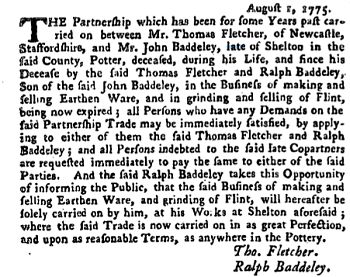
The London Gazette
15 August 1775

August 1, 1775.

THE Partnership which has been for some Years past carried on between Mr. Thomas Fletcher, of Newcastle, Staffordshire, and Mr. John Baddeley, late of Shelton in the said County, Potter, deceased, during his Life, and since his Decease by the said Thomas Fletcher and Ralph Baddeley, Son of the said John Baddeley, in the Business of making and selling Earthen Ware, and in grinding and selling of Flint, being now expired; all Persons who have any Demands on the said Partnership Trade may be immediately satisfied, by applying to either of them the said Thomas Fletcher and Ralph Baddeley; and all Persons indebted to the said late Copartners are requested immediately to pay the same to either of the said Parties. 

And the said Ralph Baddeley takes this Opportunity of informing the Public, that the said Business of making and selling Earthen Ware, and grinding of Flint, will hereafter be solely carried on by him, at his Works at Shelton aforesaid; where the said Trade is now carried on in as great Perfection, and upon as reasonable Terms, as anywhere in the Pottery.

Tho. Fletcher.
Ralph Baddeley.


Questions, comments, contributions? email: Steve Birks


Page History

  • Page created: 7 April 2007

  • Last updated: 22 April 2026 - all content added, the original page only had the period of operation.