Location and
period of operation:
|
Snow & Littler
|
Stoke
|
?
|
1879
|
|
Snow & Co
|
Stoke
|
1880
|
1882?
|
|
J
& J Snow
|
Stoke
|
1882
|
1885?
|
|
J
& J Snow
|
Hanley
|
1882
|
1908
|
|
Earthenware
manufacturers at the Albert Works, Stoke
and Pyenest Street Works, Hanley, Stoke-on-Trent,
England.
-
The
Albert Works were at Liverpool Road Stoke.
-
The
original partners were Jonathan Snow and Charles Littler - this
partnership was dissolved in August 1879 and the business continued by
Jonathan Snow.
-
The
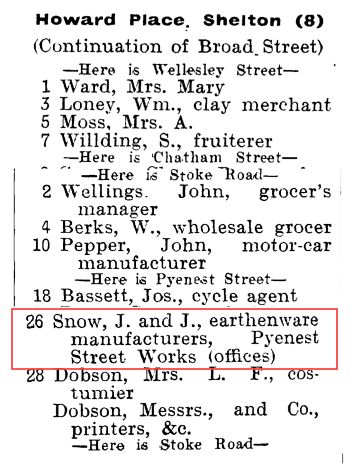
Hanley works at Pyenest Street, Howard Place were recorded as
operational in an 1882 directory.
-
The
title of the company was variously described as 'Snow, John &
James' 'Snow, John & Jonathan' and 'Snow, Jonathan &
John'
-
The business failed in 1908, following serious flooding of the Pyenest Street works by water from the adjoining canal and amid existing financial difficulties. The firm's assets were assigned to a creditor representative, and a meeting of creditors was held that year. The factory subsequently passed into the possession of the Hanley Economic Building Society, which made further attempts to let and sell the premises over the following years.
See
the account of the demise of the J. & J. Snow
business
|
The London Gazette,
September
26, 1879
 |
NOTICE is hereby given, that the Partnership heretofore subsisting between us the undersigned, Jonathan Snow, of Stoke-upon-Trent, in the county of Stafford, Earthenware Manufacturer, and Charles Littler, of the same place, Earthenware Manufacturer, carrying on business as Earthenware Manufacturers, at Stoke-upon-Trent, in the county of Stafford, under the style or firm of Snow and Littler, has this day been dissolved, by mutual consent, as from the date hereof. All debts due to or from the said partnership will be received or paid by the said Jonathan Snow, who will carry on the said business.—Dated this 25th day of August, 1879.
Jonathan Snow.
Charles Littler.
|
notice
of the dissolution of the partnership of Snow & Littler
the business to be continued by Jonathan Snow
Adverts showing the
progression of the name changes
and location of the works

Snow &
Littler
Albert Works, Stoke-upon-Trent, Staffordshire
Terra Cotta, Jet and majolica
The
Pottery Gazette, American and Canadian Edition, January 1st 1880

Snow & Co
Albert Works, Stoke-upon-Trent, Staffordshire
Porous Bottles, Flower Pots and Vase
of every description in Terra-Cotta
also a great variety of Useful Goods in Jet and Earthenware
The
Pottery Gazette, October 1880

J & J Snow
Pyenest Street Works, Hanley
and Albert Works, Stoke-upon-Trent, Staffs
The
Pottery Gazette, January 1885

moulded plate in the Imari
style
- more on the Imari
style -
Plate attributed to J J Snow
- property of the descendants of
John Snow
and passed down through the generations
Pyenest Street Works
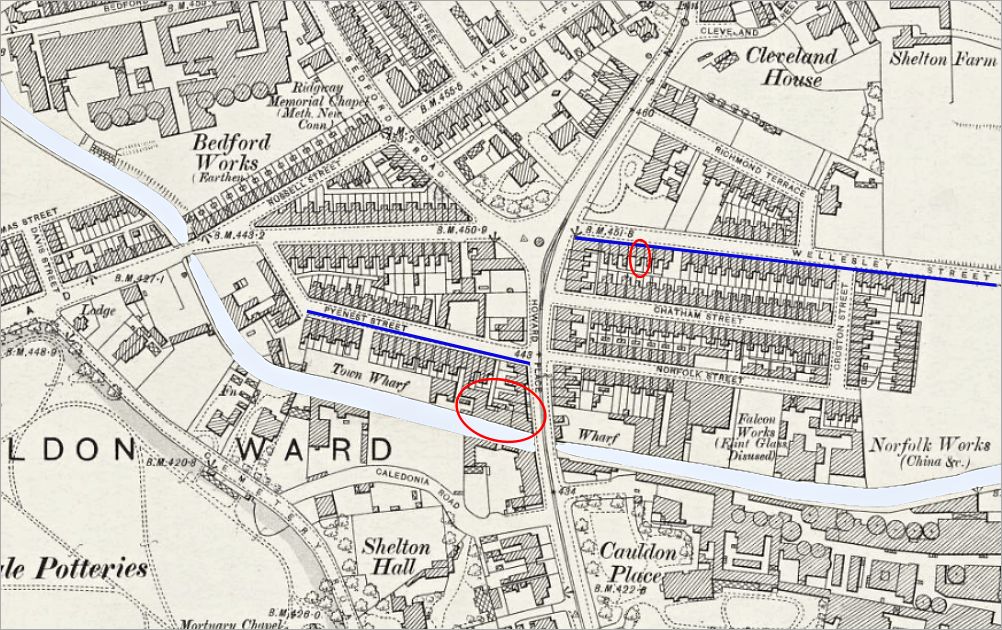
1900 OS map of the Howard
Place area of Hanley
Staffordshire
XVIII.1; National
Library of Scotland
The Pyenest Street Works are shown off Howard Place
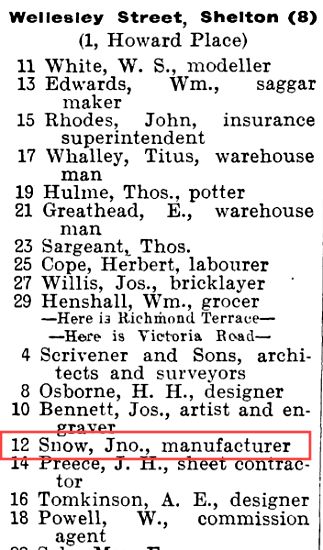
John Show lived nearby at 12 Wellesley Street
The
Caldon Canal is shown in light blue
note
at the top left Rigways large Bedford Works and at
the
bottom right the Cauldon Place works of Brown-Westhead, Moore
& Co
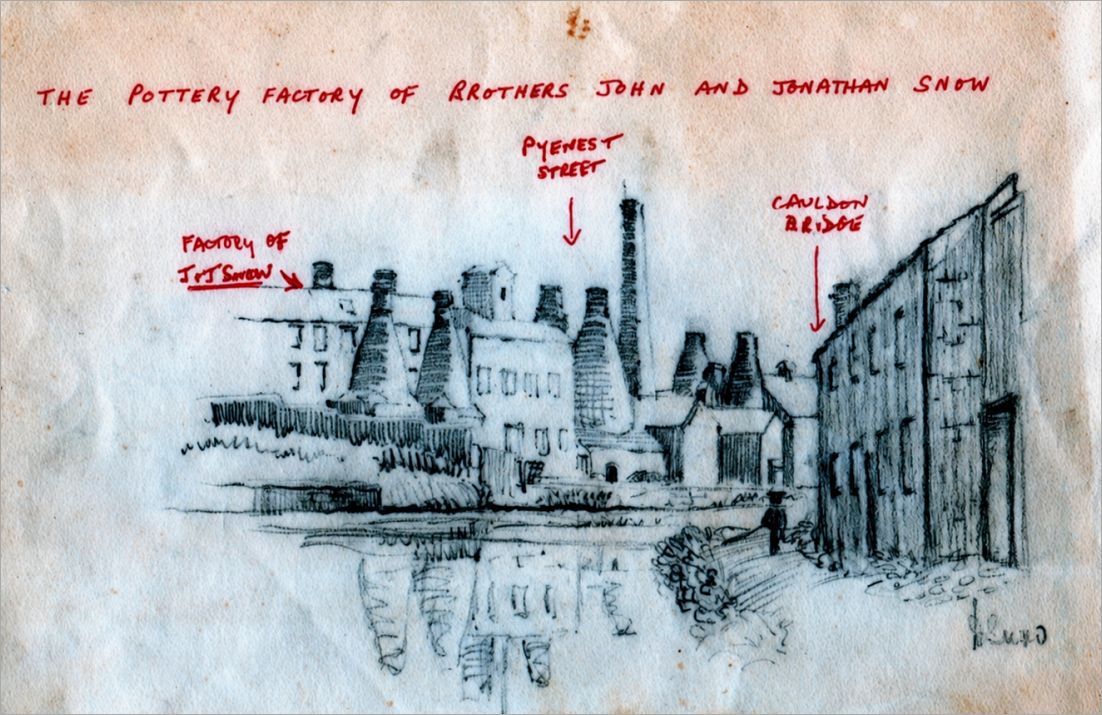
The pottery factory of brothers
John and Jonathan Snow
the works were situated alongside the Caldon Canal
a
sketch produced by Dorothy Gill (nee Snow) showing the J & J Snow pottery
factory beside the Caldon Canal in Shelton
| The business failed in 1908 amid existing financial
difficulties and following serious flooding of the Pyenest Street works by water from the adjoining
Caldon canal. |
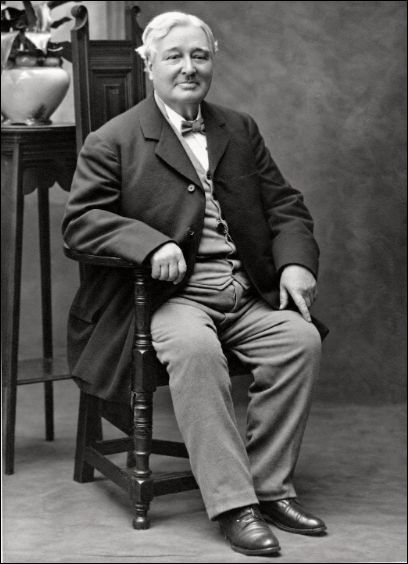
John Snow
courtesy of Mary Wright
(great great granddaughter of John Snow)
from.....
1907 Staffordshire Sentinel
'Business Reference Guide to The Potteries, Newcastle & District'

12 Wellesley Street - home of
John Snow
Google Maps - 2014
The Demise of the J. & J. Snow
business
|
The Pyenest Street Factory: Flooding and the Demise of J. & J. Snow
An important source for the final years of the Pyenest Street pottery works is a retrospective account compiled by Arthur Snow in 1954 from the records of the Hanley Economic Building Society. These records document the financial relationship between the Society and J. & J. Snow, together with the events that led to the factory falling out of the family's hands.
The business had a long-standing financial relationship with the Society. In May 1904, the Society recorded that advances made between 1885 and 1889, together with further borrowing for additions and improvements to the works, had resulted in a total liability of £1,171. Of this, £878 remained outstanding. By October 1907, J. & J. Snow were again in arrears with their mortgage payments, prompting the Society to arrange an inspection of the factory and its security.
The canal flooding of 1908
The inspection on 24 January 1908 revealed that the factory had been seriously affected by water entering from the adjoining canal. Parts of the works had actually been submerged; one portion was described as totally unworkable, while another had suffered damage to a lesser extent.
A further report, dated 19 March 1908, identified the means by which water was entering the premises. Canal water was coming through the drains and along the frontage, while drains carrying rainwater from the eaves were discharging into the canal. The surveyors recommended that the drains should be stopped up where they entered the canal and that water from the eaves should instead be carried over the canal in overhead troughs.
These entries establish that the flooding was a serious problem for the factory, affecting its working condition and requiring remedial measures. They do not, however, quantify the full financial loss caused by the flooding or establish that it alone brought about the business's failure.
The failure of the business and the Society's intervention
By May 1908, the position had deteriorated further. On 13 May, the Society's records noted a deed of assignment by J. & J. Snow to R. E. Clark, together with arrangements for a meeting of creditors. At the subsequent meeting, reported on 11 June, the assets were valued at £45, comprising £42 in stock and £3 in book debts. Preferential claims, including rates and wages, amounted to £44, leaving virtually nothing in net assets.
The Society's mortgage and its claim over the property, including the fixed machinery and fixtures, were also considered. Percy Snow was willing to rent the front portion of the works for £15 a year, provided the enamel kiln was repaired and made operational. This proposal illustrates the attempt to find a way of continuing some use of the premises despite the collapse of the business's financial position.
The records therefore show that the failure of J. & J. Snow was already being dealt with through creditors' arrangements in 1908. The precise date on which the Society took possession should be distinguished from these earlier proceedings: the entry of 15 March 1911 explicitly refers to the factory, formerly owned by J. & J. Snow, as having passed into the Society's possession following the firm's failure.
The aftermath and disposal of the works
The factory's subsequent history was one of difficulty in finding a suitable use for the premises. In July 1909, an inspection found the works unprotected and dilapidated, with the entrance gate open to trespassers. In April 1910, an application to rent part of the factory was considered, but the proposed occupation was not pursued because of concerns about the condition of the premises and the likely effect on the remainder of the works.
The Society continued to seek a satisfactory solution. In 1911, the factory was being considered for letting, while the Society also dealt with the assessment of the property for rating purposes. The records reveal the practical difficulties of maintaining and disposing of a deteriorating industrial property after the failure of its former owners.
In 1913, the Society negotiated a sale of the works to Arthur Mellor of Burslem for £750, with completion arrangements extending into 1914. These arrangements proved difficult to conclude, and further negotiations were required. The later entries document continued efforts to resolve the position.
Conclusion
The Hanley Economic Building Society records provide a valuable account of the final years of J. & J. Snow's Pyenest Street factory. The serious canal-water ingress recorded in January and March 1908 coincided with existing mortgage arrears and was followed by the assignment of the business's assets to a creditor representative and a meeting of creditors in May and June.
The evidence suggests that the flooding was an important additional blow to a business already experiencing financial difficulties. It damaged the working condition of the factory at a time when the firm was struggling to meet its obligations. Nevertheless, the records do not establish that flooding was the sole cause of the firm's failure.
By March 1911, the Society explicitly recorded the works as being in its possession following the firm's failure. The subsequent attempts to let and eventually sell the premises demonstrate how the collapse of J. & J. Snow was followed by a prolonged effort to deal with the factory as a property and financial liability.
Source: Arthur Snow, 1954, account compiled from the records of the Hanley Economic Building
Society. |
Questions, comments,
contributions? email: Steve Birks
|
Page History:
-
Last
updated: 20 October 2026 - sketch of the Pyenest Street
Works and account of the demise of the Snow business added.
-
Updated:
12 October 2026 - photos of ware and John Snow
added, map of works and 1907 directory entries added.
-
Page
created: 31 December 2014
|