|
Forester
and Hulme |
    |
Location and period of operation:
|
Forester and Hulme |
Fenton |
1887 |
1892 |
Earthenware
manufacturer at the Sutherland
Pottery, Fenton, Stoke-on-Trent,
England
|
Formerly: Thomas Forester Son & Co
Subsequently: Hulme & Christie
|
|
London Gazette
13 January 1893
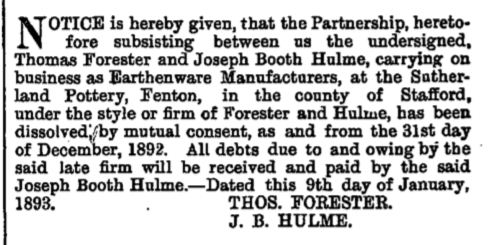
notice of the dissolution of
the partnership of Forester & Hulme
|
|
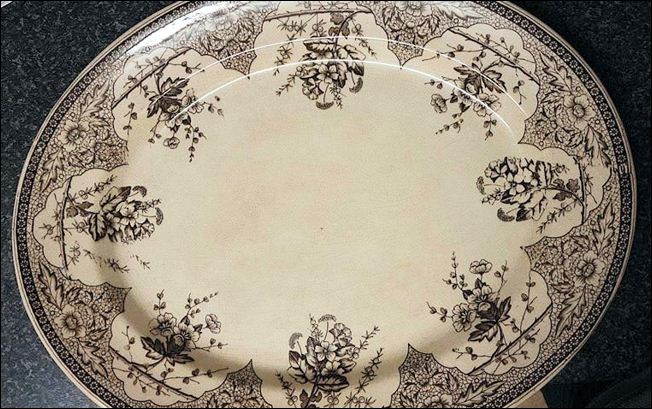 platter in the transferware Pinafore pattern |
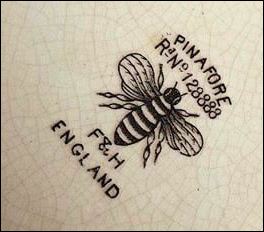 F&H England The registration number 128888 shows that the pattern was registered on the 15th July 1889 by Forester & Hulme. The inclusion of 'ENGLAND' indicate that the actual piece was made 1891-92. The use of the country of manufacture was a requirement of the American McKinley Tariff Act of 1890. |
|
|
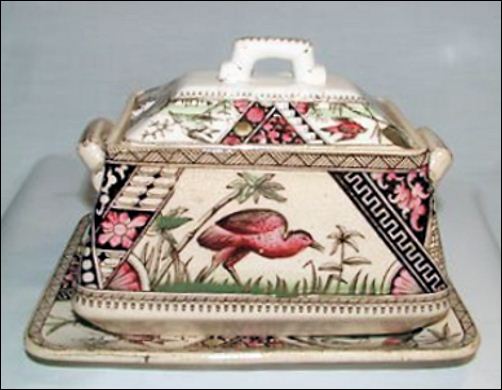
CONGO pattern
|
this example is hand coloured |
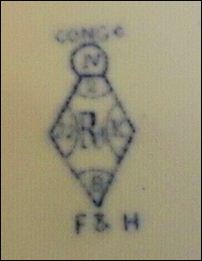
The initials 'F&H' show that the ware was made by Forester & Hulme, who operated from 1887 to 1892 The registration diamond shows that the pattern was first registered on 2 October 1883 by Meigh & Forester, Church Street, Longton. It was common for patterns/designs to pass from one company or partner to the the next. |
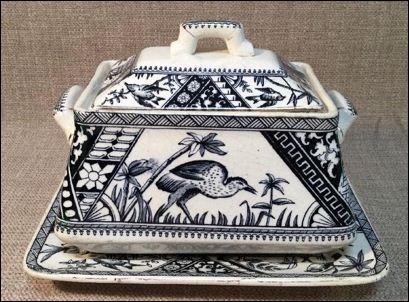
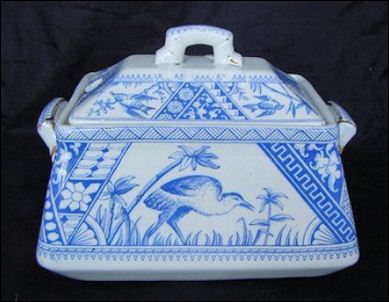
the Congo pattern was also produced in
monochrome transfer ware
|
|
|
Transfer-printed in iron-red with Aesthetic Movement/Japonisme decoration incorporating birds, foliage and geometric motifs inspired by Japanese ceramics. |
 DERBY F & H The absence of "ENGLAND" likely indicates a date pre 1891 |
Image source: Garry Sexton
|
|
Marks & initials used on ware for identification:
F&H
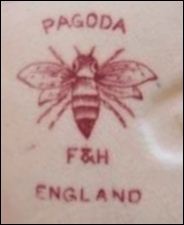 F&H England
the bee mark (a sign of industry) was
introduced by |
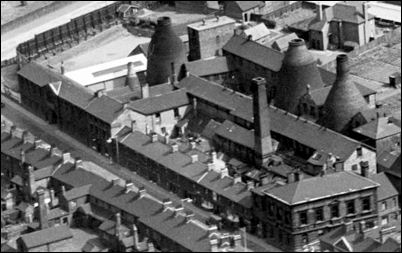
- more
on the Sutherland Pottery -
NOTE: This Sutherland Pottery in
Fenton is not to be
confused with the Sutherland Works (in Longton)
which was occupied by Hudson & Middleton.
Questions, comments, contributions? email: Steve Birks
|
|