|
|
    |
Frederick Winkle & Co Ltd main page »
Frederick Winkle & Co Ltd - registered design dispute
|
This dispute illustrates the practical importance of British design registration, where the original registration date and subsequent ownership of a pattern could determine who had the legal right to manufacture and sell it.
The registration dispute... The December 1913 issue of The Pottery Gazette carried a report of the action in which F. Winkle & Co., sued G. L. Gent & Son, for an injunction to restrain defendants from infringing a copyright design
|
| F. Winkle & Co Ltd
claimed protection of their design under the provisions of the Copyright of Designs Act 1842
Also known as the Ornamental Designs Act, - the Act was a landmark British law that formalised the protection of industrial and decorative designs. It replaced earlier, limited laws that mainly covered textiles, extending protection to a wide range of manufactured goods. The Act aimed to encourage British industrial innovation by providing a formal legal shield against "piracy" (unauthorised copying). For an explanation of British registration numbers and diamond marks, explore the Design Registration Marks page » |
jump to..
| The "Majestic" shape | Summary of the dispute | Plaintiff's
Case (F. Winkle & Co Ltd) |
| Defendant's
Case (G. L. Gent & Son) |
The Core Issue | Transcript of the Report |
the F Winkle "Majestic" shape
| G. L.
Gent & Son of London had the Longton based pottery manufacturer, Bailey & Son,
produce copies of the ewer which was a
registered design of F. Winkle & Co Ltd.
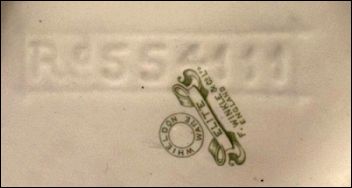
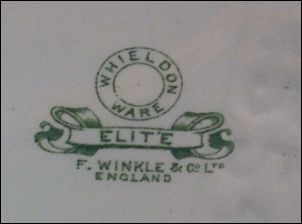
The dispute involved a toilet ewer registered by F. Winkle & Co. under Design No. 554,111 (1909). Surviving examples show both marked and unmarked versions of the same shape. The marked example confirms the legal registration of the design, while the unmarked version reflects stock circulating in the trade without visible registration identification, a central issue in the subsequent infringement proceedings against G. L. Gent & Son. |
The same design existed in the market both with and without visible legal
identification
in the form of the registration number
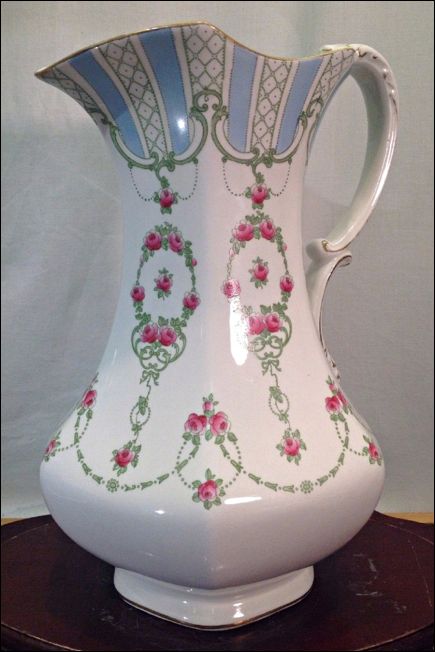
F.
Winkle & Co Ltd ewer in the "Majestic" shape - The pattern is called "Elite" |
(cast-in number)
printed mark over the cast-in number
|
|
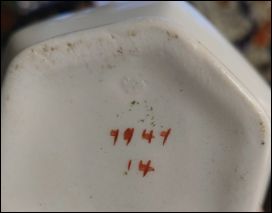
example of a F. Winkle
ewer - the hand painted number will be a decorators/pattern reference |
Evidently Winkle sold some ware in the "Majestic" shape without the design registration number. The defendants (G. L. Gent & Son) argued a 'lack of knowledge' They said that they did not know the design was registered until June 1912. Under the Patents and Designs Act 1907, they argued that the failure to properly mark goods meant plaintiffs could not claim damages until knowledge of registration existed.
|
Winkle’s case: “Our registered design was copied, knowingly, and damaged our trade.”
Gent’s case: “We acted innocently at first, stopped when told, and any liability is very limited.”

| Summary of the F. Winkle registered design dispute
The case concerns an alleged infringement of Registered Design No. 554,111 which was registered by F Winkle in 1909. This places the dispute in the Edwardian period, when F. Winkle & Co. was already well established at the Colonial Pottery. In essence, the dispute was about another pottery firm allegedly producing wares that were too close to Winkle’s registered shape, thereby copying a design that had been legally protected under the British registration system. At this date, registered designs were extremely important because:
This was especially significant in Stoke-on-Trent, where successful shapes and printed patterns were frequently imitated. Why the case matters This is important because it shows that Frederick Winkle was not merely a manufacturer but was also actively using the legal system to defend intellectual property. From the 1880s and 1890s, design registration was becoming a major commercial weapon. Potters often invested heavily in new transfer-printed patterns and moulded shapes If another manufacturer copied them, it could directly damage sales.
The dispute therefore illustrates how competitive the industry had become. Historical significance This case is interesting because it provides evidence that:
That makes it more than a routine business matter — it is evidence of how design ownership functioned in the Victorian and Edwardian ceramics trade.
|
|
Plaintiff’s case (F. Winkle & Co.) The plaintiffs’ argument had three main strands: valid ownership, copying/infringement, and commercial harm.
Defendant’s case (G. L. Gent & Son) The defence was essentially: no valid infringement claim, lack of knowledge initially, and limited liability even if infringement occurred.
Core issue the jury had to decide Ultimately, the case turned on two factual/legal questions:
The jury’s findings supported the plaintiffs on the undertaking issue, but damages were very modest (£3 12s).
In simple terms
|
For an explanation of British registration numbers and diamond
marks -
explore the Design Registration Marks page »
Transcription
of the text from The
Pottery Gazette,
December 1 1913, pp1417-8.
|
Pottery Design Dispute. — (Special Report.) — Mr. Justice Bankes and a special jury in the King’s Bench Division on Nov. 25 heard the action in which the plaintiffs, F. Winkle & Co., of the Colonial Potteries, Stoke-on-Trent, sued G. L. Gent & Son, of Holborn-circus, E.C., asking for an injunction to restrain defendants from infringing a copyright design of a toilet ewer of the registered No. 554,111. Plaintiffs also asked for an account of all articles to which the said design was applied, and of the profits made by the sale, and for the delivery up of all moulds for the manufacture of these ewers, and alternatively for damages. Defendants denied that the design in question was a new and unpublished one, and they denied that they sold any ewer to which plaintiffs’ design or any fraudulent imitation was applied. They also said that plaintiffs had failed to have their ewers property marked with the design as provided by the Patents and Designs Act of 1907. Mr. Thos. Terrell, K.C., and Mr. J. W. McCarthy appeared for the plaintiffs, and Mr. A. J. Walter, K.C., and Mr. D. M. Kerley for the defendants. Before the jury were sworn, Mr. Walter submitted the preliminary point that the plaintiffs could not maintain the action because plaintiffs were only assignees of the copyright. After some discussion between counsel, his Lordship said he thought the jury had better be sworn and hear the evidence, and give a verdict. Then he (the Judge) would give his decision, and the defendants could, if they chose, take his decision to the Court of Appeal. Counsel agreed, each side reserving all rights in the matter. The jury were then sworn, and Mr. Terrell in opening the case said plaintiffs carried on an extensive pottery business in Staffordshire, and in 1909 they desired an improved design for a toilet ewer. A design was accordingly prepared, and was registered in Dec., 1909, when the present plaintiff company was carried on as a private firm by Mr. F. Winkle. This design led to considerable success at once, some 12,000 copies being sold within a few years, and among the people who bought the design were the defendants. The design was named the “Majestic,” but was generally called the "Octagon" shape. It was subsequently found that Bailey & Son, of Longton, were making similar shapes. They were threatened with an action, and they promised they would make no more. Subsequently it seemed that defendants, who had paid plaintiffs 18s. 6d. for these shaped sets, got Bailey & Sons to supply them at 15s. 6d. They also wrote to Bailey’s : " We are under the impression that the set of ware you have of Winkles has got no registered mark. If that is so we do not think they could claim for damages." In July, 1912, the defendant Gent called on Winkle & Co. and had an interview with regard to the infringements. He said then that he did not know the design was registered, and Mr. Winkle said to him, "Well, at any rate, you know it now," and defendant was shown the registered mark. Defendant then said he would sell no more of them ; he was sorry for what had happened, and he threw the blame on Bailey & Son. He also promised orders for plaintiffs, and suggested they should go on dealing together as good friends. In August defendant wrote and sent some orders to plaintiffs, but in the following November a Mr. Porter saw some exact copies of plaintiffs’ ewers at the Hackney Furnishing Co., which were sold to that company by defendant in breach of the undertaking he had given to plaintiffs that he would have nothing more to do with any infringements. Under these circumstances plaintiffs brought the present action. Some samples of the plaintiffs’ ewers and those which were sold by defendant in alleged infringements of plaintiffs’ design were then placed on the solicitors’ table for the inspection of the jury. Mr. Terrell said the jury need take no notice of the decoration. It was the shape simply that was in question. The hearing was adjourned to the next day, when evidence was called for the plaintiffs, Mr. Arthur Ernest Winkle said in December, 1909, he and his brother traded as Winkle & Co., and on Dec. 15 of that year the design in question was registered. In May, 1912, he was informed by one of his designers that a ewer similar to his was exhibited for sale at Uttoxeter. This was bought, and it was found that it was made by Bailey & Son, who were potters at Longton. Upon inquiry they found that Mr. Gent was responsible. In July witness saw Mr. Gent on the subject. He said to witness he was sorry for his action. Witness said defendant knew quite well it was a registered design, and he said he did not. He said Mr. Bailey came to see him and bought a set of the "Majestic." Witness said Gent ought to have known that if a manufacturer bought a set he did so in order to copy it. Gent said he would not have sold it if he had known that. Witness showed him the registered number on the hollow of the ewer, and he then said he would see Bailey and advise him to cease making them. Witness saw Gent again in August, and it was then arranged that defendant should open business again with witness, who would not deal in any way with the registered design. In the following November Wright saw exposed by the Hackney Furnishing Co. a copy of the registered design. He bought the ewer and was informed it was supplied by the defendants, Gent & Son. This ewer was an infringement of witness’s copyright, and witness accordingly brought the action. He understood Baileys sold the ewer for about 14s. 6d. This design was one of the most important in their trade, and the result of defendants’ action was to seriously affect witness’s trade. Mr. Walter, K.C., for the defendants, said no damage could be recovered for general loss in a case of infringement of a design. In further cross-examination witness said he did not lower his price in consequence of competition, but he lost business. There were about 40 ewers made without the registration mark on, but these were made before the registration number was received. Cross-examined by Mr. Walter : He was not aware that he had sold to the defendant Mr. Gent some of the unmarked ewers. The price of the ewer alone was 4s. 6d., and the profit was 15 per cent. He was not aware that the total number of ewers sold by defendant since July was 30. Further cross-examined : The ewer was the only thing in the toilet set which was registered, and the basin could be bought anywhere. Witness admitted that he had got an injunction against Mr. Bailey, but had settled with him without getting any damages. He did not know how many sets Bailey made of the registered design, but it was a large number. He believed other people had bought from Bailey, but he had taken no proceedings against others. He sold the set for 18s., and he believed the price defendant sold was 21s. 6d. Mr. Walter : Defendant did not sell to the public, but only to merchants. (To witness) : You don’t suggest you lost trade because defendant sold at 21s. 6d., and you sold at 18s. 6d. 1 No, we lost because Gent bought of Bailey and not of us. Re-examined: Witness let Bailey off damages because he had no money to pay them. He proceeded against Gent, as he considered he was the prime mover in the infringement. Mr. L. H. Winkle, brother of last witness, said he was present with his brother at the interview with Mr. Gent on Aug. 29. Mr. Gent said if they would go on doing business with him he would not deal in any way with the ewer in question. Cross-examined : Nothing was said about the goods Mr. Gent had in stock. Mr. E. R. Bailey, earthenware manufacturer, of Longton, said in June, 1911, Mr. Gent, the defendant, showed witness and his father plaintiffs' ewer, and a set was sent to witness’s works which had not the registered mark on. A copy was made of that set, and the goods were decorated and sent out for sale. Subsequently witness’s firm made another ewer to avoid infringement. Mr. Terrell : We say this is a mere colourable imitation. Cross-examined : The new design was subsequently registered as an original design. As part of the settlement with the plaintiff he had destroyed the moulds of the new pattern and that of plaintiffs’ ewer. This closed plaintiffs’ case. Mr. Walter, for the defendants, said there was no contest here as to facts. It was a pure and simple question of how defendants ought to compensate the plaintiffs. Defendants admitted they had done wrong ; they had offered an undertaking not to continue infringement and a certain sum of damages, The Act of 1907 provided that if a man failed to mark goods with the registered mark, that deprived him of all claim for damages till the person infringing knew of the registration. Defendants bought from Bailey 67 ewers up to June 21, 1912, when they first became aware of the registration ; and since that time they had only sold 30. to which the plaintiffs were entitled to 15 per cent, on 30 times 4s. 6d., which would be about a guinea. They had offered an undertaking and a sum in damages, and he said in those circumstances the action ought never to have been brought. Mr. G. L. Gent, the defendant, said he had been in business for 36 years, and kept a very large stock. He remembered Bailey, senior, coming to see him in 1911, and asking for a set of plaintiffs’ design. Nothing was said at the interview as to what Bailey was going to make, and witness certainly did not instruct him to make a copy of plaintiffs’ design. Later on he saw at Bailey’s works a copy of plaintiffs’ ewers. Witness remonstrated with Bailey for having copied plaintiffs’ design, but Bailey said it was not a registered design ; and as he could not improve upon it, he copied it. Witness was not aware till June, 1912, that the design was registered. At the interview with Mr. Winkle witness told the latter he only supplied Bailey with plaintiffs’ set to show him what was selling, and not to be copied, and witness agreed not to buy any further copies of Bailey. At that time he had in stock several ewers bought from plaintiffs prior to witness being aware of the registration, and nothing was said about these. The total sales since he knew of the registration was 30 ewers. Cross-examined, he emphatically denied that he told Bailey to copy plaintiffs’ goods ; he had too i much good feeling for the plaintiffs. When he found Bailey had copied the ewer, he told him it was wrong. He admitted he had bought some from Bailey since, but he acknowledged he had done wrong in doing so, and had apologised. He did not think pottery manufacturers attached much importance to copyright, as a small variation took away the value of the copyright. He considered he had a right to sell the goods he had in stock. This closed the evidence, and counsel then addressed the jury on behalf of their respective clients. His lordship summed up the evidence, and asked the jury to say if plaintiff had satisfied them that Mr. Gent had undertaken at the interview with plaintiff not to deal any more with plaintiffs registered design. While the jury were absent, Mr. Walter argued the legal point as to whether plaintiff had a right to sue. He said the design was registered in the name of Winkle & Co. before it became a limited company ; and as there was no assignment to the limited company the plaintiff had no right to sue. Mr. Terrell having replied, at this point the jury returned, and said they had found damages for the plaintiff for £3 12s., and had by a majority agreed that the defendant undertook not to deal with plaintiffs’ design. The parties had agreed just before this to accept a majority of the jury. Mr. Walter said the defendant had paid £5 into Court, and had offered an undertaking, and therefore he asked for judgment for the defendants. Mr. Terrell said an undertaking was not an injunction, and it was the latter the plaintiff asked for by his action. His lordship eventually said he would consider his judgment and give it on Dec. 1. |
|
Page created 12 April 2026
|