

| British
Design Registration
Diamonds & Numbers |
|
Introduced by the British Copyright of Design Act 1842, these "lozenge" or "diamond" marks contained coded information about the date and material of the registration. In 1884 these diamonds were replaced by a simple sequential number. For collectors and researchers, the registration number or diamond mark is particularly valuable because it provides a firm date for the first registration of the design ( though the pattern or shape may have continued in production for many years afterwards). |
Scroll down or select from
the following sections..
|
|
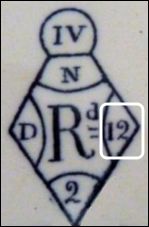
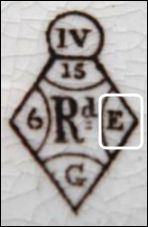
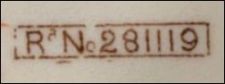
| 1843-1867 | 1868-1883 | 1884 onwards |
 |
 |
 |
marks for 1843 to 1867 have a number in the right hand corner |
marks for 1868 to 1883 have a letter in the right hand corner |
marks from 1884 onwards have the initials "Rd" or "Rd No" with a sequential number |
|
|
|
The Copyright of Designs Act 1842 (also known as the Ornamental Designs Act) was a landmark British law that formalised the protection of industrial and decorative designs. It replaced earlier, limited laws that mainly covered textiles, extending protection to a wide range of manufactured goods. The
Act aimed to encourage British industrial innovation by providing a
formal legal shield against "piracy" (unauthorised copying). Key Provisions:
How long did registration protection last? This distinction is important in cases where ownership of a design, its renewal, or its later use by another manufacturer became a matter of dispute. |
| Legal disputes
Questions of registration and legal protection were not merely matters of record, but could lead to disputes between manufacturers. An example of how design ownership and registration rights could become disputed can be seen in the case of F. Winkle & Co. |
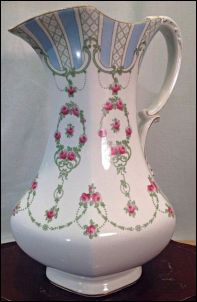 F. Winkle ewer in the "Majestic" shape. |
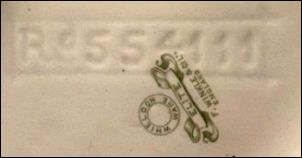
the registration number 554111 is cast-in on the bottom of the ewer, together with a printed F. Winkle & Co Ltd printed mark 'ELITE' is the name of the pattern |
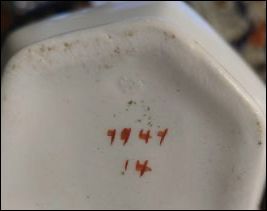 example of a F. Winkle ewer in the "Majestic" shape without any registration number or pattern name - the hand painted number will be a decorators/pattern reference |
explore
details of the registered design dispute »
|
|

Registration diamond for 1843 to 1867
marks for 1842 to 1867 have a number in the right hand corner
|
||||||||||||||||
|
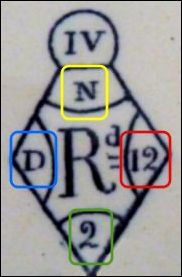
Day - Right hand corner of the diamond - this is self explanatory Month - Left hand corner - this is worked out from the code below:-
Exception Notes:
Year - Top corner - this is worked out from the code below (they are listed in alphabetical order):-
|
|||||||||||||||||||||||||||||||||||||||||||||||||||||||||||||||||||||||||||||||||||||||||||||||||||||||||||||||||
worked examples...
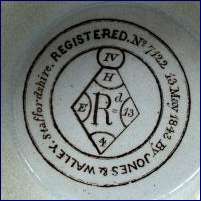 |
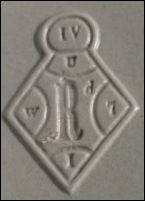 |
 |
 |
| 13th May (E) 1843 (H) | 7th March (W) 1848 (U) | 25th June (M) 1847 (F) | 11th October (B) 1861 (R) |
| Jones & Walley | Ridgway and Abington | James Edwards | Mountford & Scarratt # |
| # On the 11th October 1861 Mountford & Scarratt registered a 'jug form' - design number 144767 - it is likely that Lowe & Abberley (initials 'L & A' purchased the moulds for the jug shape at the bankruptcy sale of George Mountford. |
|
|
Registration diamond for 1868 to 1883
marks for 1868 to 1883 have a letter in the right hand corner
|
||||||||||||||||
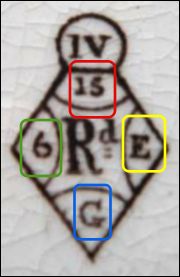
|
Day - Top corner of the diamond - this is self explanatory Month - Bottom corner - this is worked out from the code below:-
Year - Right corner - this is worked out from the code below (they are listed in alphabetical order):-
Exception notes: |
|||||||||||||||||||||||||||||||||||||||||||||||||||||||||||||||||||||||||||||||||||||||
worked examples...
 |
 |
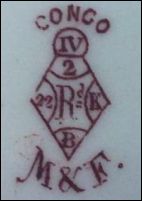 |
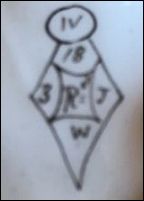
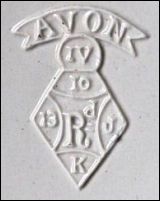
| 18th March (W) 1880 (J) | 10th November (K) 1880 (J) | 2nd October (B) 1883 (K) |
| Moore Bros. | Bednall & Heath | Meigh & Forester |
|
|
Year
table for diamond marks - in chronological
order
Exception Notes: In 1857 the letter R was used during 1-19 September, and during 1860 the letter K was used for December. From 1-6 March 1878, W was used for the year in place of D; and G was used for the month in place of W.
|
|||||||||||||||||||||||||||||||||||||||||||||||||||||||||||||||||||||||||||||||||||||||||||||||||||||||||||||||||||||||||||||||||||||||||||||||||||||||||||
|
|
Registration numbers for 1884 onwards
marks from 1884 onwards have the initials "Rd" or "Rd No" with a sequential number
| 1880s | 1890s | 1900s | 1910s | 1920s |
| 1884
1 1885 19756 1886 40480 1887 64520 1888 90483 1889 11,6648 |
1890
14,1273 1891 16,3767 1892 18,5713 1893 20,5240 1894 22,4720 1895 24,6975 1896 26,8392 1897 29,1241 1898 31,1658 1899 33,1707 |
1900 35,1202 1901 36,8154 1902 38,5180 1903 40,3200 1904 42,4400 1905 44,7800 1906 47,1860 1907 49,3900 1908 51,8640 1909 53,5170 |
1910 55,2000 1911 57,4817 1912 59,4195 1913 61,2431 1914 63,0190 1915 64,4935 1916 65,3521 1917 65,8988 1918 66,2872 1919 66,6128 |
1920 67,3750 1921 68,0147 1922 68,7144 1923 69,4999 1924 70,2671 1925 71,0165 1926 71,8057 1927 72,6330 1928 73,4370 1929 74,2725 |
| 1930s | 1940s | 1950s | 1960s | 1970s+ |
| 1930
75,1160 1931 76,0583 1932 76,9670 1933 77,9292 1934 78,9019 1935 79,9097 1936 80,8794 1937 81,7293 1938 82,5231 1939 83,2610 |
1940 83,7520 1941 83,8590 1942 83,9230 1943 83,9980 1944 84,1040 1945 84,2670 1946 84,5550 1947 84,9730 1948 85,3260 1949 85,6999 |
1950 86,0854 1951 86,3970 1952 86,6280 1953 86,9300 1954 87,2531 1955 87,6067 1956 87,9282 1957 88,2949 1958 88,7079 1959 89,1665 |
1960 89,5000 1961 89,9914 1962 90,4638 1963 90,9364 1964 91,4536 1965 91,9607 1966 92,4400 1967 92,9800 1968 93,5500 |
1970 94,4900 1980 99,3400 1990 1,061,400
|
| In August 1990, the numbering sequence was completely reset to a new range starting at 2,000,000. Any design with a number beginning with 2, 3, 4, or 6 is typically from this modern era. |
|
|
|
Details of the registrations are held at: - Representations and Registers of Designs, 1839 - 1991"A representation is a sample, picture, photograph or sketch of the registered design. The registers of designs include the allocated registered number, usually the name and the address of the owner of the design (who was not necessarily the designer), and the quantity of items registered, known as the bundle or parcel. The National Archives holds the surviving representations and registers of designs between 1839 and 1964. These documents are often very large, unwieldy and very dusty: They also have fairly complicated reference systems."
|
|
Page created 10 May 2020 Updated 13 April 2026: Page reformatted; worked examples of registration diamonds added; explanation of the 1842 Act added; details of legal dispute over the copying of a F. Winkle ewer added. |
