Henry William
Baddeley (William III)
[disambiguation of the 'William' name in this Baddeley family] |
    |
Location and period of operation:
|
Henry William
Baddeley |
Hanley |
1822 |
1846 |
Manufacturer of
earthenware in
rustic, toy, tobacco pots and terra cotta
figures at
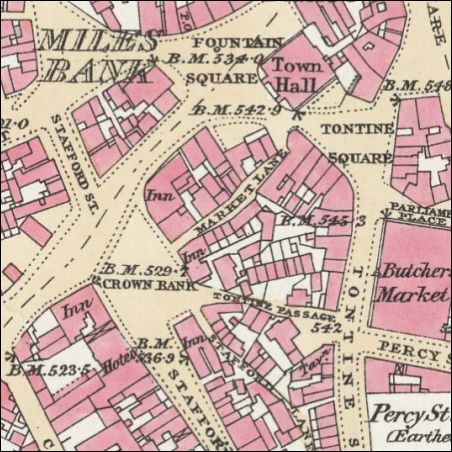
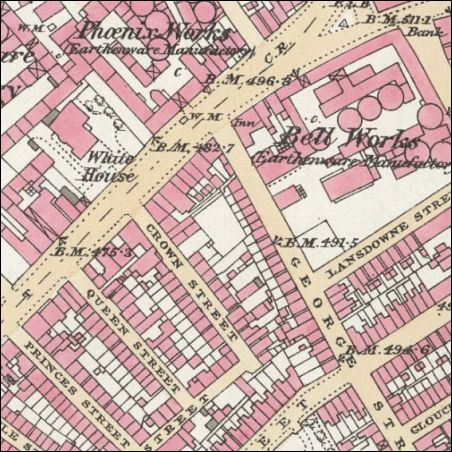
Queen Street & Market Lane,
Hanley; and then from 1846 onwards at Wharf
Street, Longton,
Stoke-on-Trent,
England.
|
Also see: The Baddeley family of potters
|
|
|
Introduction of Imitation Knife Handles After moving to Wharf Street, Longton, in 1846, Henry William Baddeley introduced a novel line of manufacture—imitation stag, buck, and buffalo horn and bone handles for knives and forks intended for the Sheffield cutlery trade. These handles, made in terra-cotta and designed to replicate natural materials, appear to have met with commercial success. However, their introduction brought Baddeley into direct conflict with the Sheffield "working handlers," who refused to fit them to cutlery. The innovation was regarded as a threat to established crafts, and a campaign of intimidation followed: threats were issued to manufacturers, warnings given that works would be destroyed, and on one occasion Baddeley himself was attacked when visiting Sheffield. Under such pressure, the trade in these handles was abandoned. This episode reflects the wider climate of industrial tension in Sheffield during the period, later exemplified by the so-called Sheffield Outrages, in which new methods and materials were sometimes resisted with extreme measures.
Wikipedia article on the Sheffield Outrages » |
|
|
account of Henry William
Baddeley
in Jewitt's Ceramic Art of Great Britain, 1878
| see the whole of Jewitt's account on the Baddeley family » |
"..The works at Eastwood having been sold, his* son, William Baddeley#, commenced in Queen Street, Hanley for the manufacture of terra-cotta articles; and a large trade was carried on in earthenware knobs for tin and japanned tea and coffee-pots. He also made fancy pipes, japanned terra-cotta, and other goods.
At the Market Lane Works, he was the first to make telegraph insulators in iron moulds with screw and lever pressure.
In 1846, the works were removed to Longton (Wharf Street), and here the manufacture of imitation stag, buck, and buffalo-horn and bone handles for knives and forks for the Sheffield trade was first introduced.
In this branch, a very good trade was done, but the working handlers of Sheffield refused to work them up, and threats were sent to several masters that if they did not give up the terra-cotta knife-handle trade their works would be blown up.
The masters, thus intimidated, gave up the use of these handles, and on Mr. Baddeley visiting Sheffield an attack was made on his life. Letters were sent to him on his return threatening that, if he did not give up making the handles, he and his works 'would be done for'. The manufacture was then discontinued.
The manufacture was then discontinued. Mr. Baddeley "invented the thimble placing rack, now so extensively used; this he sold to Elias Leak, of Longton, who, in 1856, took out a patent for the invention."
Mr. Baddeley, who died in 1864, held the St. Martin's Lane Works, and his widow [Elizabeth] carried on business in Commerce Street from 1864 to 1875.
Jewitt's Ceramic Art of Great Britain, 1878, pp401,402
*William Baddeley II.
#Henry William Baddeley (William Baddeley III)Confusingly Henry William Baddeley often went by his middle name and is referred to in some accounts and trade directories as 'William Baddeley' - to add to the confusion his father and grandfather were both named William and so was his son.
|
|
Henry William Baddeley's Hanley and Longton Works
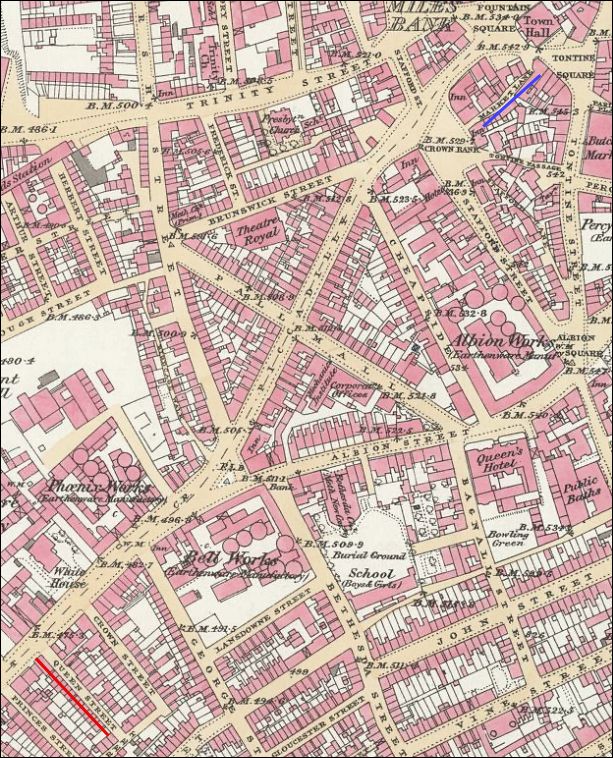 1879 map of Hanley town centre showing the relative location of Queen Street and Market Lane
|
"At the Market Lane Works, he was the first to make telegraph insulators in iron moulds with screw and lever pressure"
"in Queen Street, Hanley for the manufacture of terra-cotta articles; and a large trade was carried on in earthenware knobs for tin and japanned tea and coffee-pots. He also made fancy pipes, japanned terra-cotta, and other goods" |
|
|
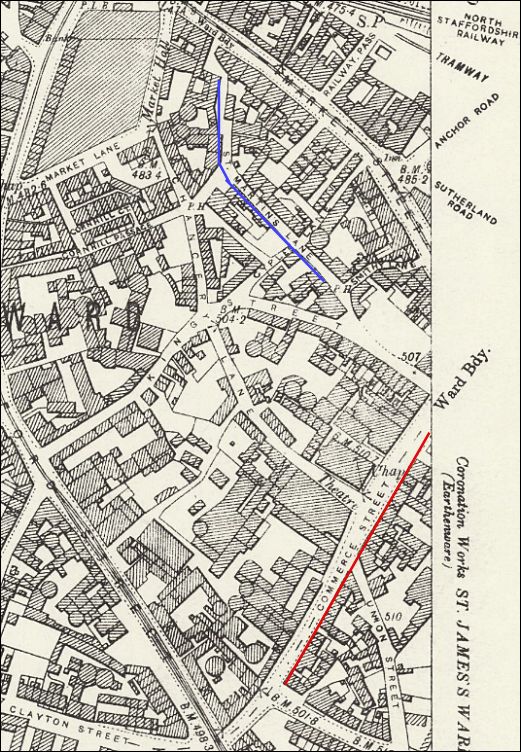 1900 map of Longton town centre showing the relative location of St. Martin's Lane and Commerce Street. The Ordnance Survey map shown was revised in 1898 and published in 1900 - so is some 50 years after the move to Longton. |
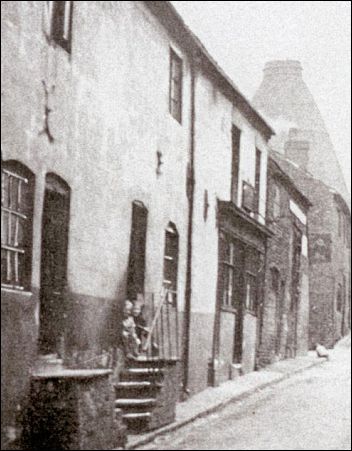 St. Martin's Lane, Longton in the 1930's This typical scene, long vanished, was in St. Martin's Lane, Longton. One visiting writer described it as "Victorian industrialism in its dirtiest and most cynical aspect" explore more on St. Martin's
Lane »
Mr. Baddeley, who died in 1864, held the St. Martin's Lane Works, and his widow [Elizabeth] carried on business in Commerce Street from 1864 to 1875.
|
Questions, comments, contributions? email: Steve Birks
|
|