
| The Baddeley family of potters |     |
|
The Baddeley family are among the earliest and an important pottery families, originating at Eastwood and later potting in Hanley and Longton - their history in the Potteries extending from the early 18th century into the late 19th century.
This page brings together the principal members of the Baddeley family of potters, showing the development of the family from the early Eastwood pottery through to their later Longton works. |
|
There
is no known relationship between these two pottery families. |
|
[disambiguation of the 'William' name in this Baddeley family] Confusingly Henry William Baddeley, grandson of William (I) often went by his middle name and is referred to in some accounts and trade directories as 'William Baddeley' and so for clarity is referenced here as 'William III' |
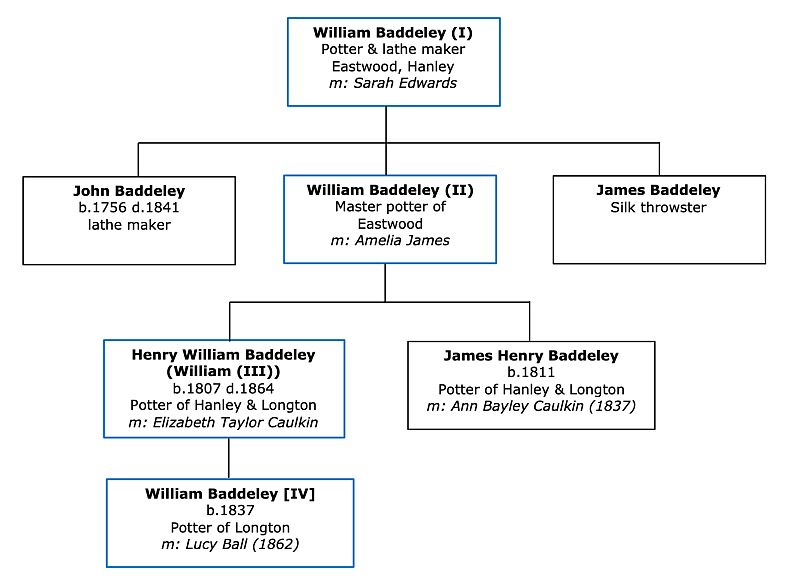
Baddeley family tree showing a
summary of the four generations with the "William" name
and the Eastwood,
Hanley and Longton pottery branches
dates may be approximate
|
|
Summary of four generation of the Baddeley family of potters
:
NOTE: This summary is based on trade directories and later 19th-century accounts;
some details derive from retrospective sources.
| William Baddeley (I) |
Established the family pottery at Eastwood, Hanley.
|
|
|
|
|
John Baddeley b.1756 d.1841
|
First son of William Baddeley [I].
|
|
|
|
|
William Baddeley (II) b.1780 m. Amelia James |
Second son of William Baddeley [I], brother of John Baddeley.
|
|
|
|
| James Baddeley |
Third son of William Baddeley [I]. James was a 'Silk throwster' of Eastwood, Hanley.
|
|
|
|
|
Henry William
Baddeley b.1807 d.1864 m. Elizabeth Taylor Caulkin
|
Confusingly Henry William Baddeley often went by his middle name and is referred to in some accounts and trade directories as 'William Baddeley' and so for clarity is referenced as 'William III'
|
|
|
|
|
James Henry Baddeley b.1811 d.1890 m. Ann Baylay Caulkin (1837) |
Son of the second William Baddeley [II].
|
|
|
|
|
William Baddeley (IV) m. Lucy Ball (1862) |
The son of Henry William and Elizabeth Baddelev - opened a factory for similar products called Drury Works, Normacot Road, Longton.
|
|
|
|
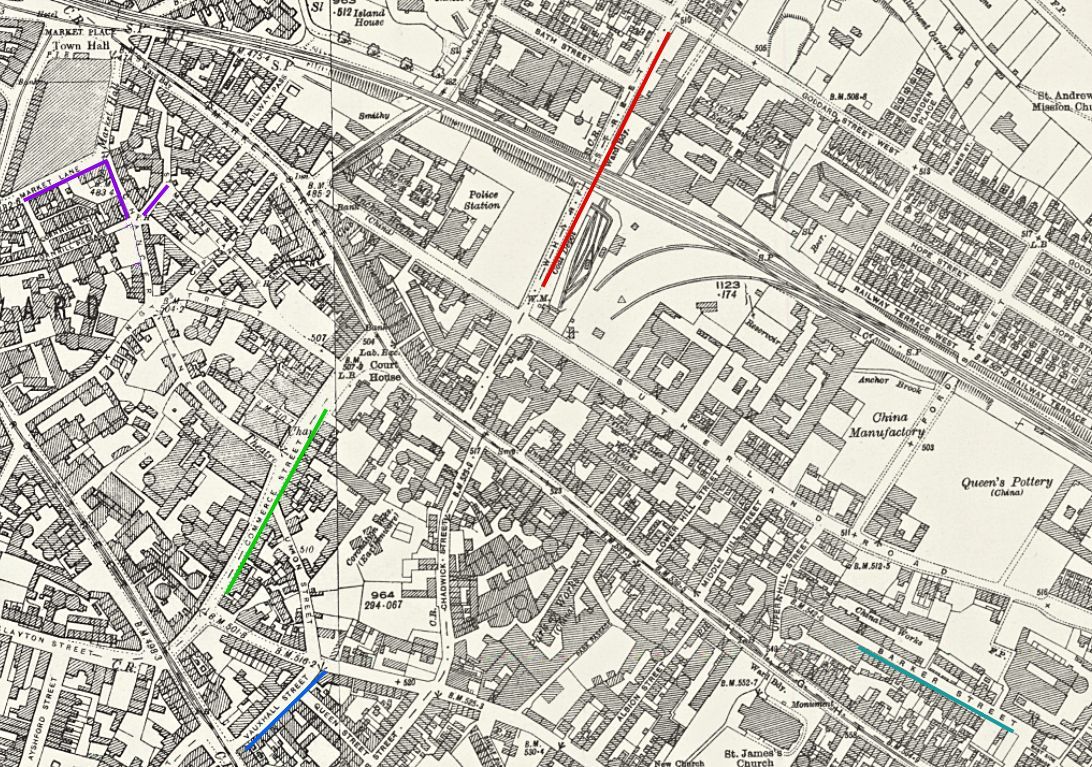
Longton Potteries operated by the Baddeley
family
| Factory | Operated by | approx period | |
| 34 Barker Street |
|
James Henry Baddeley | 1869-75 |
| Market Lane Works |
|
Henry William Baddeley | - 1846 |
| Wharf Street & St. Martins Lane |
|
Henry William Baddeley | 1846-64 |
| St. Martins Lane / 3 Commerce St |
|
Elizabeth Baddeley | 1864-75 |
| Drury Works, Normacot Rd / Vauxhall St |
|
William Baddeley Lucy Baddeley |
1862-75 1875-82 |
|
account of the
Baddeley family of potters |
|
Accounts such as this can helpful in filling gaps in knowledge, but need to be handled carefully - this account covers a wide period of some 30 to 150 years before the time of writing - such history narratives can sometimes mix solid fact with anecdote and a bit of embellishment. For example:
|
|
"Baddeley. — About 1720 William Baddeley (an old name in the district) commenced making brown ware at Eastwood, Hanley. About 1740, having invented an "engine-lathe," he began to make "turned articles in cane and brown ware. He was succeeded in the pottery by his son, William Baddeley; his other son, John Baddeley, taking the business of the lathe making, by which he acquired a competency, and died in 1841, aged eighty-five." This second William Baddeley made many improvements in the ware, and attempted, both by an imitation of body of his vitreous wares, and by his mark, to palm off some of his goods as Wedgwood's. His mark was the word EASTWOOD impressed on the ware, but he contrived always to have the EAST indistinct and the WOOD clear (EASTWOOD), thus hoping to catch the unwary by the latter syllable. He died at an advanced age, and the works at Eastwood having been sold, his son, William Baddeley, commenced in Queen Street, Hanley, for the manufacture of terra-cotta articles, and a large trade was carried on in earthenware knobs for tin and japanned tea and coffee-pots.
The works were in 1846 removed to Longton (Wharf Street), and here the manufacture of imitation stag, buck, and buffalo-horn, and bone handles for knives, forks, &c., for the Sheffield trade, was first introduced.
The manufacture was then discontinued. Mr. Baddeley "invented the thimble placing rack, now so extensively used; this he sold to Elias Leak, of Longton, who, in 1856, took out a patent for the invention." Mr. Baddeley, who died in 1864, held the St. Martin's Lane Works, and his widow now carries on business in Commerce Street. Their son, William Baddeley, commenced manufacturing in the Normacott Road, in 1862. His productions were rustic terra-cotta articles for floral, horticultural, useful, and decorative purposes ; the principal articles being fern-stands, vases, flower-stands, hyacinth-pots, flower-pots, garden-seats, flowerbaskets, mignonette-boxes, crocus-pots, globe-stands, brackets, inkstands, &c. The designs were all taken from nature, and appropriate to the intended use of the vessel. His imitations of bark, &c., and of various woods and plants, were remarkably good." Jewitt's Ceramic Art of Great Britain, 1878, pp 401, 402. |
Questions, comments, contributions? email: Steve Birks
|
|