|
Index | Pottery | Pottery manufacturers | Charles
Meigh & Son |
    |
| [Meigh
& Walthall] 1790-1802 |
[Job
Meigh (&Son)] 1802-1834 |
[Charles
Meigh] 1835-1849 |
[C
Meigh, Son & Pankhurst] 1850-July 1850 |
[Charles
Meigh & Son] Jul 1850-Mar 1861 |
[Old
Hall Earthenware Co Ltd] Mar 1861-Jul 1886 |
[Old
Hall Porcelain Works Ltd] 1886-1902 |
Location and period of operation:
|
Charles Meigh & Son |
Hanley |
July 1850 |
March 1861 |
|
Charles Meigh & Son was one of the most respected pottery manufacturers operating in Hanley, Stoke-on-Trent Staffordshire, during the mid-Victorian period. Trading under this name from 1850 to 1861, The firm continued the long-established Meigh family tradition at the Old Hall Works and developed a reputation for producing wares that combined practical domestic use with decorative quality. Their output ranged from everyday household ceramics such as plates, dishes, teacups, jugs, and cake stands to more refined table services marked “Improved Felspar,” “Stone China,” or “Opaque Porcelain,” terms used to denote a whiter, finer and more durable earthenware body. Alongside these domestic wares, Charles Meigh & Son became especially noted for their richly moulded and ornamental pieces, including relief jugs, Gothic Revival designs, and highly decorative presentation wares that appealed to the growing Victorian middle class. The crispness of their moulding and the quality of their glazes placed them above the level of purely utilitarian Staffordshire pottery, while their best decorative pieces compared favourably with other leading Hanley makers of the period. |
Earthenware
manufacturer at the Old
Hall Works, Hanley,
Stoke-on-Trent, England
|
Previously: Charles Meigh, Son & Pankhurst
Subsequently: Old Hall Earthenware
Overview of quality and range:
The production of Charles Meigh (& Son) covered three main levels of ware, from everyday domestic pieces to highly decorative exhibition work.
| 1) Everyday domestic
tableware
This formed a substantial part of their output. In common with many earthenware manufacturers typical items included:
|
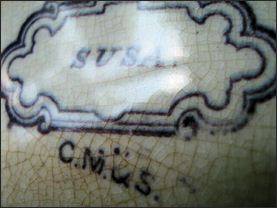
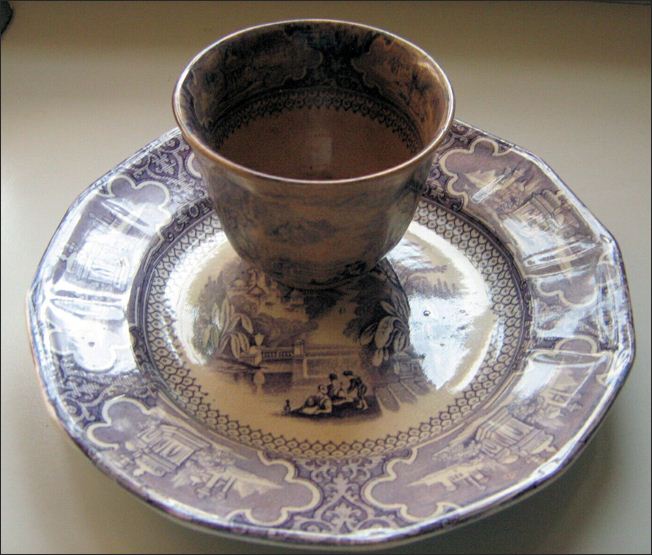 cup and plate in the SUSA pattern |
 Improved Stone China
|
this pattern was originaly made by the predecessor Charles Meigh, Son & Pankhurst
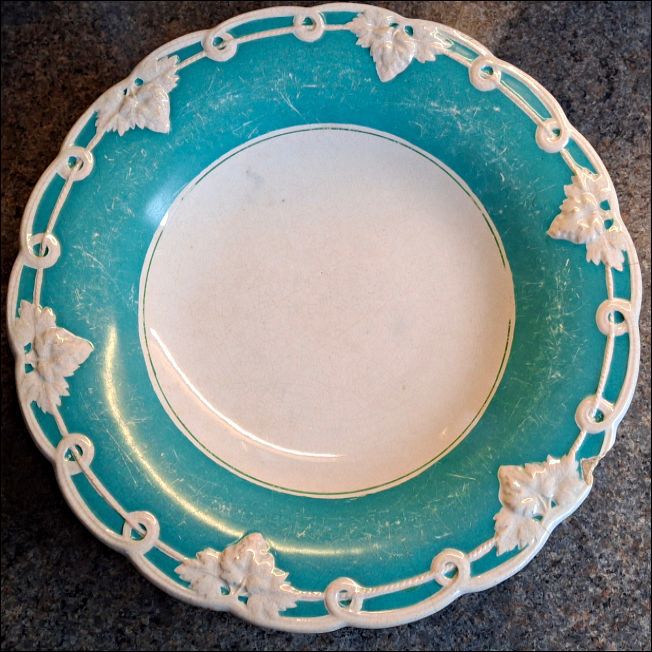 relief moulded cake stand with hand colouring
|
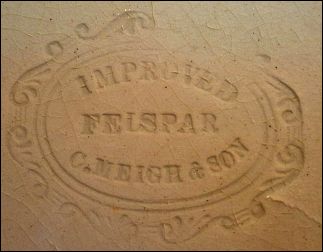
“Improved Felspar” does not refer to a pattern name. It describes the body of the ware.
|
photos courtesy: Nicola Webb
| 2) Decorative and
better-class household ware
This is where Meigh really built a reputation. They produced:
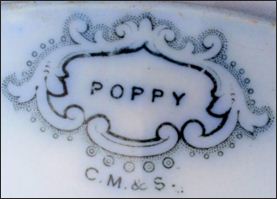
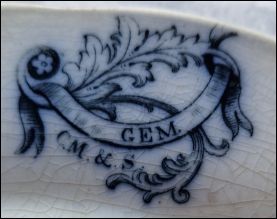
Patterns such as Poppy and Gem show the better decorated side of their output. |
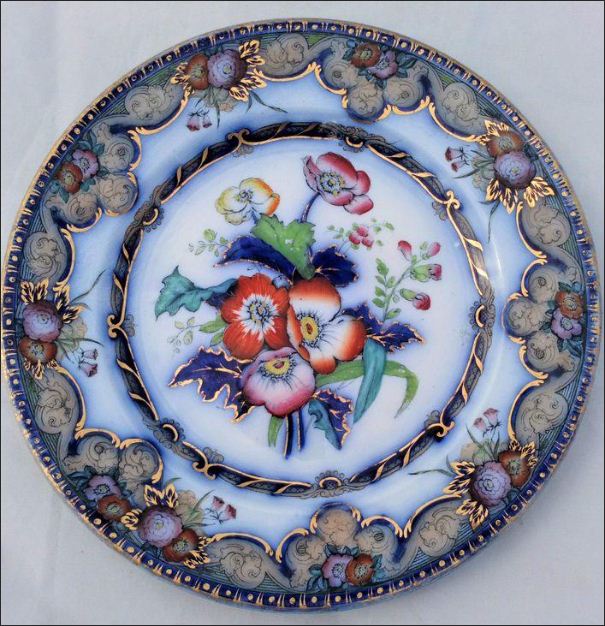 hand painted plate in the Poppy pattern |
 printed faux Chinese mark Improved Stone
China
all these marks appear on the same plate |
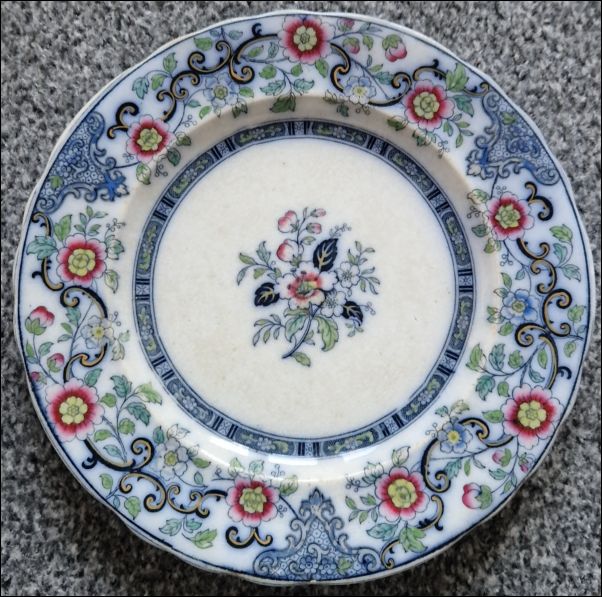 plate in the GEM pattern |
 faux 'Oriental' mark
|
photos courtesy: Jordan Shepley
|
3) High-quality ornamental and exhibition pieces
Charles Meigh (& Son) produce high-quality ornamental and exhibition pieces - They also exhibited at the Great Exhibition of 1851, which demonstrates a maker of recognised quality as well as merely everyday ware.
|
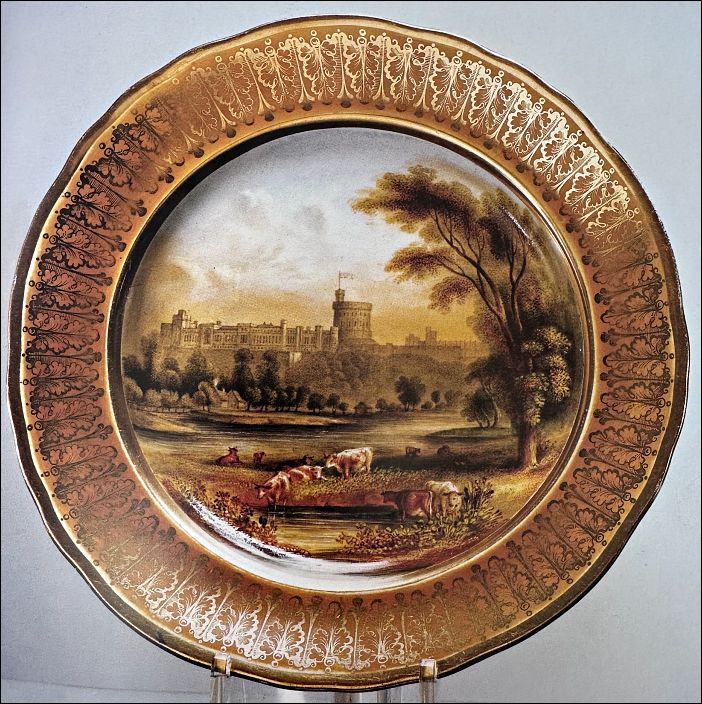 "A superb quality Charles Meigh hand-painted 'Opaque Porcelain' plate of 1851 Exhibition type and standard" Godden - Guide to Ironstone, Stone & Granite Wares, colour plate 43, p.51 |
"I show in Colour Plate 43 a magnificent and high decorative Charles Meigh earthenware plate which would seem to be of the quality included in the firms stand at the 1851 Exhibition. This hand-painted example bears an impressed Charles Meigh 'Opaque Porcelain' mark but over this has been applied a Royal Arms mark with the inscription 'Ironstone China' incorporated in the ribbon below. I here reproduce this rare mark"
Godden - Guide to Ironstone, Stone & Granite Wares, p.286
|
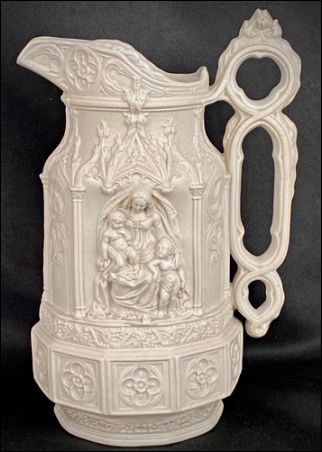
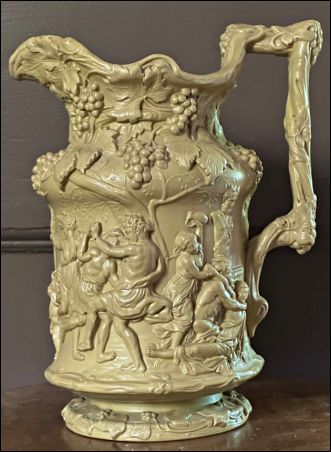
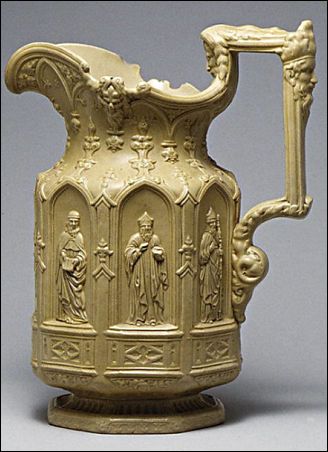
Examples of high-quality
crisp moulded relief stoneware, Gothic
Revival jugs
such jugs were registered by Charles Meigh and Charles Meigh & Son
- see Dick Henrywood's site on Meigh's Relief Moulded Jugs -
Initials and Marks used on ware for identification:
C M & S
C MEIGH & SON
MEIGH'S CHINA
M & S
|
Godden
(Encyclopaedia of British Pottery and Porcelain Marks, p.429) states
that However
in his later book (Guide to Ironstone, Stone & Granite Wares,
p.287) he notes that "American authorities have attributed 'M.
& S.' initial marks to Charles Meigh & Son. This seems very
unlikely. I believe that the full initials 'C. M.
& S.' were used. |
IMPROVED FELSPAR
|
“Felspar” (an older spelling of feldspar) is a mineral added to the clay mix to create a harder, whiter, finer earthenware or ironstone body. |
OPAQUE PORCELAIN
IMPROVED STONE CHINA
ENAMEL PORCELAIN
| These names were partly technical and partly marketing terms, suggesting a refined, whiter, harder body intended to rival porcelain.
The word “Improved” was very much Victorian sales language. |
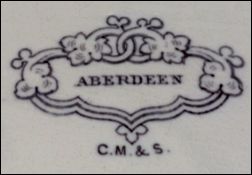 C. M. & S.
|
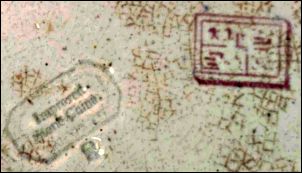 Improved Stone China
(photo enhanced) |
all of these marks appear on the same plate

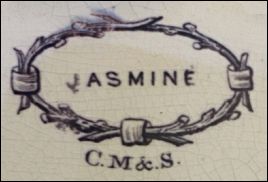
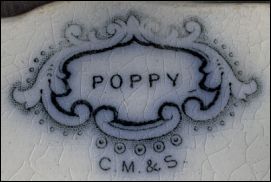
C. M. & S.
the initials C. M. & S. appear on a range of different printed marks, the name of the pattern is generally included
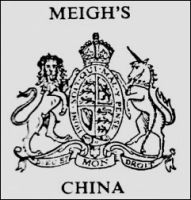 Meigh's China Godden (Encyclopaedia of British Pottery and Porcelain Marks, p.429) |
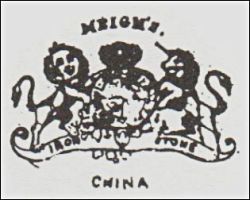 Meigh's China Iron Stone Godden - Guide to Ironstone, Stone & Granite Wares, p.286 |
rare marks incorporating the British Royal Arms
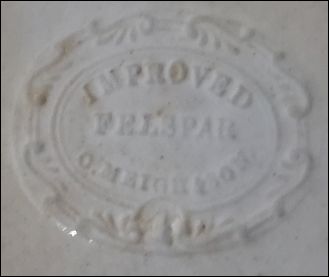
Improved Felspar
C. Meigh & Son
“Felspar”
(an older spelling of feldspar) is a mineral added to the clay mix
to
create a harder, whiter, finer earthenware or ironstone body.
faux marks imitating those used by Chinese porcelain manufacturers
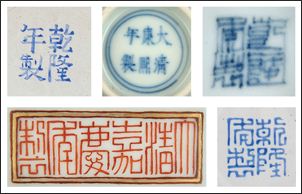
shown above are examples of
marks used by
Chinese porcelain manufacturers
The Meigh family (& other
potters) added similar
marks to their ware to give the impression of the Orient
to their ware even though it was produced in England.
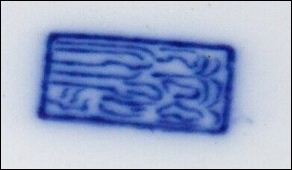
this style of mark was also used
by Job Meigh & Son and Charles Meigh & Son
 |
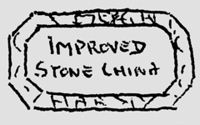 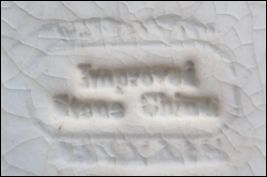 Improved Stone China around the border: Meigh Hanley other wording included "Indian Stone China" or "French China" |
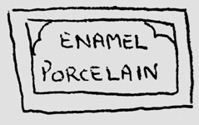 Enamel Porcelain |
marks recorded in Godden's 'Encyclopaedia of British Pottery and porcelain Marks'
these style of marks were also used by Job Meigh & Son and Charles Meigh
The Old Hall Works
1790-1902
| The Old Hall Works in Hanley, Stoke-on-Trent, was one of the most significant pottery factories of the 19th century, famously operated by the Meigh family from its inception until its later transition into a limited company and beyond. |
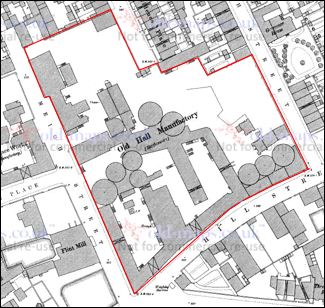
- more on the Old Hall Works -
Questions, comments, contributions? email: Steve Birks
|
Page created 9 July 2022 Updated 20 August 2025: Introduction expanded; example of SUSA pattern added Last Updated 30 March 2026: Introduction expanded; examples of the three main levels of ware added; marks section expanded. |