 |
 |
 |
 |
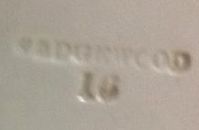 |
| W.S.
& Co's Queens Ware WEDGEWOOD |
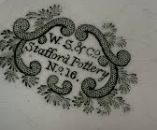
W.S.
& Co Stafford Pottery |
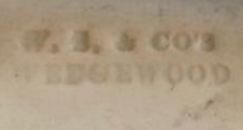
W.S.
& Co's WEDGEWOOD |
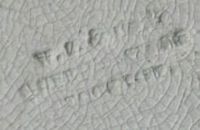
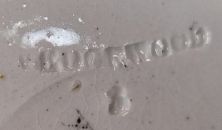
WEDGEWOOD | VEDGEWOOD |
| thepotteries.org |
The Wedgwood Name – Misuse and Misidentification
[ History of Josiah Wedgwood & Sons ]
|
Few names in the history of British pottery are as widely recognised as Wedgwood. The reputation established by Josiah Wedgwood during the eighteenth century made the name synonymous with quality, innovation and fine craftsmanship. As a result, the Wedgwood name became one of the most valuable commercial assets in the ceramics industry—and one that others were tempted to imitate, exploit or, in some cases,
legitimately happened to share.
Although the marks discussed on this page may appear similar at first glance, each has a different story to tell. Knowing the differences not only helps collectors identify pottery correctly but also provides an insight into the changing ways in which manufacturers protected their names and reputations, from the nineteenth-century law of passing off to the trade mark legislation of the twentieth century.
|
|
|
Exploitation of the Wedgwood Name:
| William Smith & Co. | - deliberate passing off leading to the 1848 injunction. |
| John Wedg Wood | - a trading name apparently chosen to resemble Wedgwood. |
| Stephens & Co. | - trade mark infringement and the 1905 public apology. |
| German imitations | - German manufacturered ware advertised as "Wedgwood" |
| Wedgwood & Co. | - misidentified with completely separate pottery company. |
| The Digital Age | - an attempt to exploit the Wedgwood name in the internet age. |
|
|
William Smith & Co. – Passing Off as Wedgwood
In a highly influential 1848 landmark dispute, Francis Wedgwood (Josiah's grandson)
successfully obtained a formal court injunction against William Smith & Co.
William Smith & Co. operated the Stafford Pottery at Stockton-on-Tees between about 1825 and 1855. Although the company was not based in Staffordshire, it deliberately adopted names and marks intended to make buyers believe its products were genuine Wedgwood ware.
The firm's methods included:
The intention was not simply to imitate the style of Wedgwood's products but to persuade customers that the wares were connected with the famous Etruria manufacturer. |
|
|
|
|
|
| W.S.
& Co's Queens Ware WEDGEWOOD |
W.S.
& Co Stafford Pottery |
W.S.
& Co's WEDGEWOOD |
WEDGEWOOD | VEDGEWOOD |
|
Concerned by this deliberate misuse of its name, the Wedgwood firm (trading as Josiah Wedgwood & Sons) commenced proceedings in the Court of Chancery.
On 9 November 1848, the Court made the injunction perpetual. Smith & Co. consented to the order and agreed to pay Wedgwood's legal costs. Rather than abandoning the deception altogether, Smith & Co. simply altered the spelling of the mark. Later wares appear with impressed marks such as:
These spellings were sufficiently different to avoid breaching the wording of the injunction, while remaining visually similar enough to mislead purchasers into believing they were buying genuine Wedgwood products. As Geoffrey Godden later observed, the deception was effective enough that examples in the collections of the Victoria and Albert Museum were at one time catalogued as genuine Wedgwood before their true origin was recognised.
|
|
|

John Wedg Wood - Trading on the Wedgwood Name
|
At the same time (the 1840s to
1850s) as the injunction against William Smith & Co, John Wedg Wood was operating his Hadderidge pottery in Burslem and using the spaced mark "J. WEDG WOOD" John Wedg Wood, a great-grandson of Ralph Wood, appears to have adopted the middle name "Wedg" specifically to exploit the reputation of the celebrated Wedgwood pottery.
Despite repeated claims in later pottery literature, no contemporary evidence has been found that
John Wedg Wood was the subject of the same or a separate injunction, and this appears to be a confusion with the 1848 legal action against William Smith & Co.
|
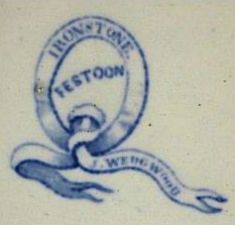
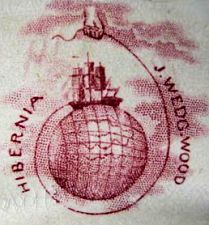
Marks of John Wedg Wood
note the small gap or dot
between Wedge and Wood
the firm of Josiah Wedgwood & Sons never used the initial "J"
before Wedgwood
|
|
Stephens & Co. - Misuse of the Wedgwood Trade Mark
|
By the beginning of the twentieth century, the protection of well-known pottery names had been strengthened by trade mark legislation. In 1905, Stephens & Co., of 40 Royal Arcade, Cardiff, publicly admitted that they had advertised and sold pottery as "New Wedgwood Blue" even though the goods had not been manufactured by Josiah Wedgwood & Sons Ltd. The company acknowledged that, although the misuse was described as inadvertent, it had wrongfully used the Wedgwood name and its registered trade mark. As part of the settlement, Stephens & Co. issued a formal public apology, expressed regret for the infringement, and undertook not to repeat the offence. The published apology illustrates the increasing legal protection afforded to established pottery brands and demonstrates that, by the early twentieth century, manufacturers were prepared to enforce their registered trade marks as well as their commercial reputation.
|
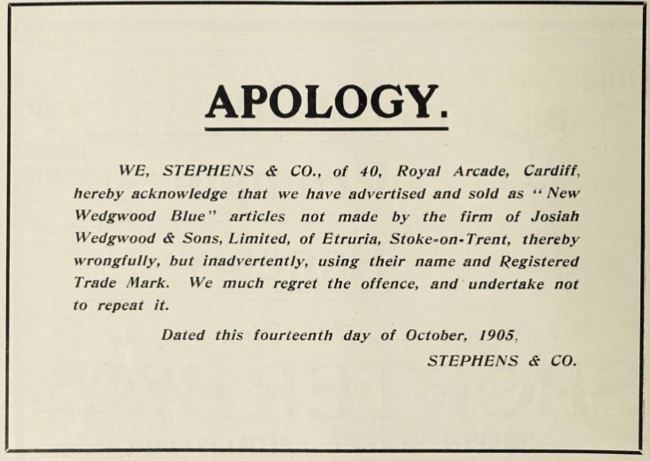
Apology from Stephens & Co who wrongly used
the Trade Mark of Josiah Wedgwood & Sons
|
APOLOGY.
Dated this fourteenth day of October, 1905, STEPHENS & CO. |
Pottery Gazette - January 1906
|
|
German Imitations and the High Court
| During the late nineteenth and early twentieth centuries, several German manufacturers produced jasper-style wares inspired by Wedgwood's famous designs. Among the best known were Schäfer & Vater and the Volkstedt factories. Although these wares often copied Wedgwood's colours and classical relief decoration, they were generally made using different materials and manufacturing methods, and are usually distinguishable by their factory marks and construction.
While inspired by Wedgwood's famous jasperware, the jasper-style wares produced by German manufacturers such as Schäfer & Vater and the Volkstedt factories are now recognised as collectible ceramics in their own right. Although they should not be mistaken for genuine Wedgwood, they represent an interesting chapter in the wider history of European ceramics and are appreciated by many collectors for their own artistic and historical merit. |
|
The value of the Wedgwood name made it a frequent target for imitation. In 1906, Josiah Wedgwood & Sons Ltd successfully brought a High Court action against London retailers Farmer & Sons for selling imported German jasper ware as "Wedgwood". The copies closely imitated Wedgwood's recently introduced City of London Arms jasper ware, matching the size and colours so closely that they were difficult to distinguish from genuine pieces when viewed from a short distance. During the hearing, Wedgwood explained that genuine jasper ware was produced by a complex process in which the white relief decoration was separately modelled and carefully applied to the coloured body before firing. The German copies were moulded in a single operation, making them much cheaper to manufacture despite their superficial resemblance. Photographs of the retailer's window display showed the imported goods openly advertised as "Wedgwood". The defendants admitted the infringement, agreed not to contest the case, apologised, and the High Court granted a perpetual injunction restraining further misuse of the Wedgwood trade mark, together with an order for costs.
The following contemporary report provides a detailed account of the case as it appeared in the trade press. The Pottery Gazette, March 1906 (p.351)
|
|
|
Wedgwood & Co. – A Common Collector's Misidentification
|
Not all apparent "Wedgwood" marks are the result of deliberate imitation or passing off.
The wares of Wedgwood & Co. are frequently misidentified by collectors as products of Josiah Wedgwood & Sons Ltd. simply because of the shared surname. In reality, the two businesses were entirely separate for well over a century. An easy way to distinguish them is that Josiah Wedgwood's company never traded as "& Co." Consequently, any backstamp bearing the words "Wedgwood & Co." or "Wedgwood & Co. Ltd." can be confidently attributed to the separate manufacturer rather than the famous Etruria firm.
» explore further - Wedgwood & Co
|
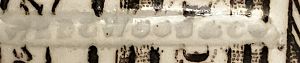
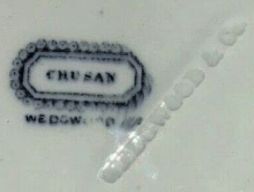
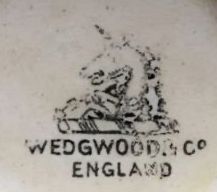
Wedgwood & Co printed
and impressed marks
|
|
The Digital Era – Evolution of the Wedgwood Trademark Dispute
|
The deceptive strategies once used by nineteenth-century potters to exploit the prestigious Wedgwood name have evolved into the internet age. Where William Smith & Co. used the location name "Stafford Pottery" together with a concealed middle "E" ("WEDGEWOOD") to mislead consumers into buying generic earthenware, and makers such as John Wedg Wood relied on typographical separation, modern bad-faith actors have adopted misleading internet domain names and websites.
A notable example occurred in 2023, when the World Intellectual Property Organization (WIPO) ruled in favour of Fiskars UK Limited and Fiskars Oyj Abp, owners of the Wedgwood trade marks, in a dispute concerning the domain wedgwood.top (WIPO Case No. D2023-1021).
An Internet Archive (Wayback Machine) snapshot captured on 8 February 2023, only weeks before the WIPO
complaint was filed, preserves the appearance of the website prior to its removal. The archived pages show how the Wedgwood name, branding and historical references were presented to reinforce an appearance of authenticity.
This deliberate manipulation of the words - Wedgwood, J Wedgwood (in Wedgwood's distinctive handwriting) and the foundation date 1759 - echoes the techniques employed more than a century earlier by traders seeking to exploit the reputation of Josiah Wedgwood. Just as firms such as Stephens & Co. of Cardiff were challenged for marketing non-Wedgwood wares as "New Wedgwood Blue", the operators of wedgwood.top attempted to exploit the goodwill associated with one of Britain's best-known ceramic brands.
The case also serves as a reminder that professional-looking websites are not necessarily genuine. Collectors should always verify that they are dealing with the official Wedgwood website or an authorised retailer before making a purchase.
» explore further - read the World Intellectual Property Organization ruling |
|
|