|
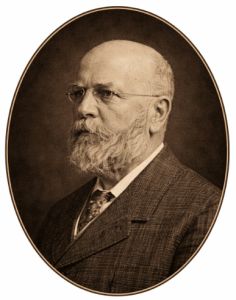
Portrait of Frederick Winkle from The Pottery Gazette, 1 October 1908. [photo digitally enhanced] |
Frederick Winkle (1845–1908) Founder of the Colonial Pottery, Fenton, Frederick Winkle rose from child apprentice to become one of the leading pottery manufacturers in the Potteries. Establishing the Pearl Pottery in Brook Street, Hanley in 1881 and the Colonial Pottery in 1888. Renowned for his practical skill, progressive methods, and successful expansion into sanitary ware, he became one of the most respected manufacturers in the district. |
|
Frederick Winkle
(26 April 1845–10 September 1908)
Born in 1845, he entered the pottery trade at an exceptionally early age. At around eight years old, he was taken by his father to work at Baker & Company’s earthenware manufactory in Fenton, where his father was employed as a saucer maker. He was later apprenticed at the same works, beginning a lifelong career in pottery manufacture. While working full-time in the trade, Winkle attended evening classes at the
Fenton Athenaeum, developing a strong interest in reading, technical knowledge, and self-improvement which remained with him throughout his life.
Early career After completing his apprenticeship, Winkle worked as a journeyman cup and saucer maker at several local potteries, including John Edwards of Fenton. He later secured employment at Mintons in Stoke-on-Trent, one of the leading potteries in the district, where he further developed his technical and managerial knowledge. After a period of about one to two years, he was appointed potters’ manager at Cauldon Place. These early experiences gave him a strong grounding in both the practical and organisational sides of the industry.
Formation of the business In 1881, Frederick Winkle entered into partnership with Thomas Hines and William Wood, establishing a pottery business in Brook Street, Hanley, known as the Pearl Pottery. Following Hines’s retirement, the business continued as Winkle & Wood and expanded steadily. In c.1888, the partners acquired land in Whieldon Road, Fenton, where they erected a modern eight-oven manufactory, continuing under the name Winkle & Wood. This became the Colonial Pottery. The works were considered highly efficient for their time and were strategically located near both the Trent and Mersey Canal system and the North Staffordshire Railway, allowing efficient distribution of raw materials and finished goods. The business expanded rapidly and ultimately employed around 500 workers, making it one of the largest earthenware manufactories in Fenton.
Colonial Pottery and production The Colonial Pottery developed a wide-ranging and successful output, including:
The firm became noted for its willingness to adopt new machinery and production methods, and was among the early adopters of automatic and labour-saving equipment in the Potteries industry. Winkle’s practical background was clearly reflected in the design and operation of the works, which were regarded as among the best equipped in the district.
Partnership changes and later control Following the withdrawal of William Wood in late 1889, Frederick Winkle continued the business as F Winkle & Co, supported by a sleeping partner. From this point onward he assumed full responsibility for the management and direction of the Colonial Pottery. In later years, his sons Arthur and Lawrence Winkle became actively involved in the running of the business.
Public and local life Frederick Winkle was widely respected in the Potteries district and took an active role in civic and commercial affairs. He was connected with:
He was also closely associated with local sporting life, particularly cricket and bowls.
Character and reputation Winkle was regarded as a practical, progressive, and technically-minded manufacturer. His early training as a working potter gave him a strong understanding of production, which earned him the respect of his workforce. He was known for maintaining cordial relations with employees, being approachable and willing to address legitimate grievances. His workforce recognised his technical knowledge and experience, which contributed to loyalty and efficiency within the works.
Death Frederick Winkle died on the early morning of Thursday 10 September 1908 at his residence, Greenfield House, Mount Pleasant, Fenton, following a bronchial illness which developed into heart failure. He had been active at the works only a week before his death. He was buried at Fenton Public Cemetery on 12 September 1908, in the presence of a large gathering of relatives, friends, business associates, and employees. The funeral was attended by representatives from both the manufacturing and commercial sides of the pottery industry. He was survived by his widow, described as a Worcester lady, and his two sons, Arthur and Lawrence.
See also |

| Timeline of
the life of Frederick Winkle
This timeline is compiled from information in the obituaries in The Pottery Gazette, October 1, 1908 and Staffordshire Sentinel, Monday September 14, 1908. |
| Year | Age | Event |
| 26 April 1845 |
Born Grew up in Fenton, Staffordshire. |
|
| 1853 | 8 |
Began work at Baker & Co
Taken by his father to work at Baker & Company’s earthenware manufactory, Fenton. |
| late 1850s | teens |
Apprenticeship
Apprenticed to Baker & Co. |
| c. 1860s | 20s |
Journeyman cup and saucer maker
Worked in several pottery workshops as a journeyman saucer maker. |
| c. 1870s | 30s |
Mintons / Cauldon Place
c. late 1870s
1874 onwards |
| 1881 | ~36 |
Founded Pearl Pottery partnership
Christmas 1881 |
| 1888 | ~43 |
Colonial Pottery established In 1888, land was acquired in Whieldon Road, Fenton, where a new eight-oven manufactory was erected. This became the Colonial Pottery.
1883
c. 1880s–1890s |
| 1890 | ~45 |
Sole control after Wood withdrew
William Wood withdrew from the partnership.
1890s
1895 |
| c. 1902 | ~57 |
Fire-clay sanitary ware added six years before death, added fire-clay sanitary ware production. |
| 10 September 1908 | 64 |
Died Residence: Greenfield House, Mount Pleasant, Fenton
Final illness |
|
Buried in Fenton Public Cemetery Survived by His widow (described as “a Worcester lady”) two sons: Arthur and Lawrence |
| The Pottery
Gazette, October 1, 1908
FREDERICK WINKLE.— Aged 64. It
is with deep regret that we record the death of Mr. Frederick Winkle,
the senior partner in the firm of F. Winkle & Co., Colonial Pottery,
Stoke-on-Trent, and the founder of the business. The deceased had for
some time suffered from a bronchial affection, which recently
intensified a heart trouble.
He commenced as a boy on the lowest rung of the ladder, and by his indomitable perseverance he worked his way through every stage until he achieved his ambition and became a manufacturer himself.
The Colonial Pottery owes its present high position in the trade almost entirely to the energy, determination, and practical knowledge of its founder. The success of Mr. Winkle, like that of the others referred to, proves most forcibly the value of a practical training in the work of production to all who aspire to control a pottery. We appreciate to the full the importance of theoretical and scientific instruction, but all experience shows that the student who is thoroughly trained on these lines alone, with no actual practical knowledge, is handicapped in competition with the youth who has "gone through the mill.” Mr. Winkle may be said to have been born to the trade. His father was employed at an earthenware manufactory at Fenton, and apprenticed him to the same firm. On the conclusion of his apprenticeship, he worked as a journeyman cup-maker at various factories. While he was learning his trade he took advantage of the night schools opened at the Fenton Athenaeum, and there acquired that taste for sound literature which he displayed and improved to the end of his life. Having, as a workman, obtained a practical knowledge of the industry, he became a diligent student of the theoretical and scientific phases of pottery manufacture, and attained considerable proficiency in them. In the successful production and ornamentation of pottery, theoretical and practical knowledge are both essential. Mr. Winkle has demonstrated that the youth with a practical training may become proficient in the theory and science of potting as he growls older. It might not be impossible, but it would not be so easy, for one whose early tuition had been confined to theory to obtain any useful practical experience afterwards. The deceased was always bent on improving his position and after other engagements, he obtained employment at the famous factory of Minton’s, Stoke-on-Trent. When he had been there a year or two he was appointed potters’ manager at Cauldon-place works. Desirous of becoming a manufacturer himself, he entered into partnership with Mr. T. Hines and Mr. W. Wood, and took a lease of some property in Brook-st., Hanley, where they commenced business in a quiet way. Mr. Hines retired from the firm, and the business w as continued by Mr. Winkle and Mr. Wood. Mr. Winkle’s practical ability proved af great value to the firm, and the business steadily increased, outgrowing the capacity of the original premises. The partners realised that with improved facilities and more extended accommodation they could increase their trade, and they looked about them for larger works. None being at the time available, they obtained possession of some land at Fenton, and exactly twenty years ago they built and at once occupied what is now known as the Colonial Pottery, in the Whieldon-road. The works, which include an eight-oven factory, occupy upwards of two acres cf ground, and are considered to be amongst the best-equipped potteries in the district. They are designed in the most convenient manner, and are fitted with the most up-to-date labour-saving and time-saving machinery and appliances. In the general arrangement of the works, and particularly in some of the methods adopted, the practical experience of the late Mr. Winkle is plainly indicated. He was one of the first to make extensive use of certain automatic machines which are now so largely employed in the industry. It is not too much to say that the Colonial Pottery has now working resources that are second to none, as no expense has been spared in keeping everything well up to date. The North Staffordshire Canal (Trent and Mersey Navigation) and the North Staffordshire Railway afford facilities for the transit of raw materials and manufactured goods. When Mr. W. Wood withdrew from the firm about nineteen years ago, Mr. Winkle was joined by a gentleman who was a sleeping partner only, the whole management of the business devolving upon the deceased. He was, however, fully equal to the task, although, with upwards of five hundred employees to deal with, it could not be considered a light one. Happily his relations with his workpeople were always of the most cordial nature. He was ever ready to listen to any complaints, and if there was a real grievance he was quick to rectify it. Another advantage of his early business training was this. His employees all knew he was well versed in every detail of the trade, and there is no doubt they worked all the better and with more satisfaction, under a principal who was himself a craftsman and for whose practical knowledge and skill they could not but entertain great respect. In recent years Mr. Winkle’s two sons have assisted him in the conduct of the works. The firm have a wide reputation for their toilet sets, dinner services, and suite ware for the home and colonial markets, and it was the constant study of the late principal to keep these well up to date in form and ornamentation. He knew that the taste of the public, both at home and in the Colonies, is always subject to change, and it was his constant aim to meet it. About fourteen years ago he commenced to make sanitary earthenware, and eight years later included the manufacture of Diamond Enamelled Fire-clay Sanitary Goods. In these goods a large trade has grown up. Quite recently the late Mr. Winkle showed his enterprise, and the resources of his works, by adding another new branch to his already many-sided business. He introduced an Art Section, in which, with other novelties, the new' “ Whieldon ” ware is produced. This was the last and perhaps the most ambitious of the many developments carried out by the deceased. The late Mr. Winkle was absorbed in his business. He took no active part either in political or local government affairs, though lie had often been asked to sit on the Board of Guardians for Stoke and the Fenton Council. He was a member of the Chamber of Commerce and of the Manufacturers’ Association, a director of the Staffordshire Potteries Waterworks Company, and was interested in Hill’s Foundry, Fenton. His recreation was bowling, and he was president of the Fenton Bowling Club, and for many years he supported the Fenton Cricket Club, of which he was vice-president. He was a man of fine physique, and of an exceedingly affable and courteous disposition. The funeral took place at the public cemetery, Fenton, on Sept. 12, in the presence of a large number of relatives, friends, and business associates. The employees of the Colonial Pottery headed the funeral procession, and in the long line of coaches which formed it, was one containing London and Provincial representatives of the firm, while the officials of the works were joined by a crowd of intimate friends in the rear. |
| Staffordshire
Sentinel, Monday September 14, 1908 The Late Mr. F. Winkle A Prosperous Career From Saucermaker to Manufacturer
In conjunction with Mr. William Wood and the late Mr. Thomas Hines, Mr. Winkle, at Christmas, 1881, set up in business. The firm secured on lease some unoccupied property in Brook-street, Hanley, and here the firm set themselves seriously to make ware best calculated to find a ready market. Mr. Winkle's own practical experience became exceedingly useful to the young and happily speedily thriving industry. Mr. Hines, however, saw reason to withdraw his interests, leaving the concern in the hands of his former partners, the works for a few years longer being carried on by Messrs. Winkle and Wood as the Pearl Pottery. Matters progressed so satisfactorily that Mr. Winkle and his partner saw their way, with greater opportunities of output, to a very considerable increase in their business. Consequently, in 1888 some land in Whieldon-road, Fenton, was obtained, and on the site was erected an eight-oven manufactory, into the construction of which every modern device was applied. The new works are large, compact, and well-designed, are near the water way and the North Staffordshire railway system, the carrying of the heavy raw materials and manufactured products being thereby reduced to a minimum.
They certainly are not by a very long way, for the home trade is a very important and an improving factor. On Mr. Wood's withdrawal from the firm, a course he took in or about 1890, Mr. Winkle took a sleeping partner, and conducted the business single-handed, receiving, in more recent years, valuable assistance in the management from his sons, Arthur and Lawrence. The Colonial manufactory of Messrs. Winkle was and remains known as a thoroughly up-to-date concern. Mr. Winkle, though by no means ostentatious, prided himself on his readiness to give attention to any invention which might be brought to his notice; and if, after due consideration, his practical mind suggested that the new method was worthy a fair trial, a fair trial it would secure at the Colonial Pottery. In this way the firm were practically the first to jolly ewers. Owing, in a measure at all events, to the improved facilities afforded them by Mr. Winkle the workpeople took very kindly to the innovation, being able to earn more money by the new than they were by the old way. On the whole, Mr. Winkle got on exceedingly well with his workpeople. He was always ready to listen to any reasonable complaint; and it was well understood throughout the works that anyone with a grievance—boy, girl, man, or woman—would find the head of the firm both approachable and reasonable. It was very seldom during his business career that he felt himself compelled to take a strong attitude towards any section of his workpeople. On one occasion he decided upon taking what was to him the extreme and even painful course of summoning a number of transferrers before a court of justice, but the Bench, by their decision, justified the action he had taken. The people who made it a necessity to refer the matter to an outside tribunal, however, were allowed to return to their work, and never afterwards heard any unpleasant reference to the matter. Mr. Winkle put on the market what he described as opaque-porcelain goods. The ware had a great run, and was one of the main causes of the remarkable success achieved. No manufacturer devoted more time to making experiments, and the hold the firm has on the buyers of this and other countries is unquestionably the result of the improvements effected from time to time in body and form, the outcome of the continuous labours of the principal.
The deceased gentleman was a member of the Manufacturers’ Association; the Chamber of Commerce; he was a director of Hill’s Foundry at Fenton; had been interested in a local Building Society since 1874; for forty years he had been closely identified with the leading cricket club at Fenton, filling the more important offices; he was president of the Fenton Bowling Club and tennis court, the playing of bowls being his principal diversion. Mr. Winkle was a fine, powerfully built man, entirely free from pretentiousness. To the friends of his youth and early manhood he remained most loyal, whether those friends continued at the bench, where he found them, or whether they had risen with him in the social scale. To the less fortunate he was a true friend Mr. Winkle was one of those men who did not in matters of charity allow his left hand to know what his right hand did. The deceased gentleman never sought public life; neither could he be induced to enter it. He had been nominated for seats on the Fenton Council and on the Stoke Board of Guardians, but he declined, solely on the ground that his business demanded every minute of his time. In politics he was broad-minded, with a leaning towards the Unionist cause. He attended Church of England services. On Thursday week Mr. Winkle, on returning home, suffered from a
bronchial cold. The next day he remained at home; and the severity of
the attack being noted, Dr. Moody was called in. On Saturday the
deceased took to his bed, and despite every attention which could be
given him by his medical adviser, Mrs. Winkle, and members of the
family, he gradually got worse, and ultimately succumbed shortly after
three o’clock on Thursday morning. He leaves a widow—a Worcester
lady—and two sons. THE FUNERAL. The remains of the late Mr. Frederick Winkle were laid in their last resting place, the public cemetery, Fenton, on Saturday. Long before the mournful procession was timed to leave deceased’s residence, quite a large crowd of sympathetic onlookers had gathered. Blinds generally in the vicinity were drawn as an evidence of respect to the memory of the deceased. Shortly after three o'clock the cortege left Greenfield House. It proceeded, amid very exceptional manifestations of sorrow, past the cricket and bowling club grounds. At both places games were in progress; and at each ground, where a flag was flying half-mast, play was suspended while the procession moved forward. Heading the procession were the employees of the Colonial Pottery, following whom came the deputations from the Fenton Tennis and Bowling Club. The subsequent order was as follows:
At the cemetery the cortege was met by the Rev. C. P. T. Clarke (vicar), and the Rev. J. Wilson, priest-in-charge of St. Paul's, Mount Pleasant, who joined in the procession to the chapel. Here the burial service was very impressively conducted by the Vicar, the special lessons being read by the Rev. J. Wilson. At the graveside a large concourse of sympathisers had assembled to pay their last tribute of respect. The committal rites were impressively solemnised by the Vicar. Amongst the numerous wreaths noticeable were the following:—
The coffin, which was of dark polished oak, with heavy brass mountings, had inscribed on the plate:—"Frederick Winkle. Born April 26th, 1845; died September 10th, 1908; aged 64." The whole of the arrangements were very creditably carried out by Messrs. M. Huntbach and Co., Ltd., Hanley. |
|
Page created 11 April 2026
|