|
|
||
|
|
 |
|

| Index | The meaning of the British Royal Arms | Change in the Royal Arms in 1837 | English potters use of the Arms | American potters - Royal Arms to National Symbols | English potters use of 'American' Symbols |
|
American Potters: From Royal Arms to National Symbols |
|
|
American and British Potters: Rivalry and Influence
Imported Wares DominateUntil the late 19th century, most tableware used in the United States was imported—mainly from Britain. That began to change in the 1870s and 1880s, when American potters started producing white “granite ware” for the domestic market.
New Centres of ProductionNew centres of production quickly emerged. Trenton, New Jersey became a major hub, with potteries such as City Pottery, while East Liverpool, Ohio developed into another key area, home to firms including Knowles, Taylor & Knowles and Homer Laughlin & Co.
Even so, early American ironstone often had simpler shapes than English imports, and British-made wares remained the preferred choice for many buyers.
Marketing and ImitationTo compete, some American potters took a subtle marketing approach. Many pieces were left unmarked, while others carried designs that echoed the British Royal Coat of Arms. Phrases such as “Royal China,” “Royal Blue,” “Royal Semi-Granite,” and “Imperial China” were also used—carefully chosen to suggest an English origin.
A Warning from England
British manufacturers were well aware of what was happening—and they weren’t pleased. In 1894, the English firm John Maddock & Sons issued a pointed warning in their price list:
“This stamp is being imitated. It is easier to imitate the stamp than the goods.” #
The message was clear: while marks could be copied, quality could not.
A Shift to American IdentityOver time, American ceramics improved significantly, and consumer confidence grew. As a result, potters gradually moved away from British-inspired symbols and began to adopt more distinctly American imagery, including the American eagle and Stars and Stripes flags and shields.
# William C. Gates Jr., The East Liverpool, Ohio Pottery District: Identification of Manufacturers’ Marks (Paducah, KY: Collector Books, 2009), quoting John Maddock & Sons price list, 1894: “This stamp is being imitated. It is easier to imitate the stamp than the goods.”

|
Examples of American Potters using the British Royal Coat of Arms |
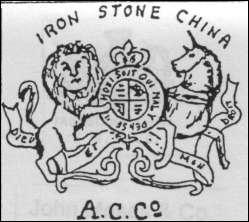 Iron Stone China A.C.Co |
||
|
American Crockery Co In 1876 the American Crockery Company was manufacturing white ironstone ware. They made use of the British Royal Coat of Arms with the Lion, Unicorn, Shield and both mottos.
|
||
|
|
|
|
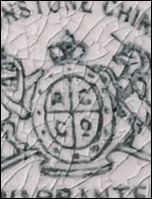
 American China Co Ironstone China Warranted |
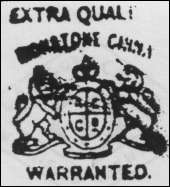 Extra Quality Ironstone China A C Co Warranted |
 |
|
American China Co. Use of part of British Royal Coat of Arms with the Lion, Unicorn - with the letters A C Co in the Shield. |
||
|
|
|
|
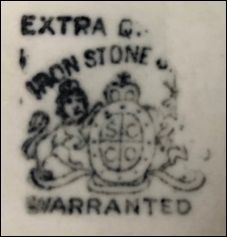 Extra Quality Iron Stone China S C C O Warranted |
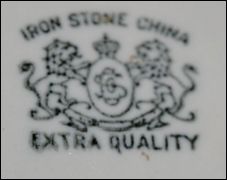 Iron Stone China S C Co Extra Quality Marks similar to those of the American China Co with the use of the wording "Extra Quality" but with the initials SCCO |
|
|
|
|
|
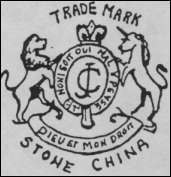 Trade mark JC Stone China |
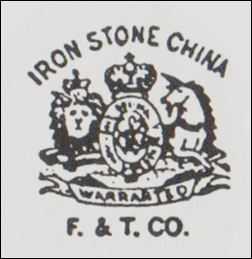 Iron Stone China Warranted F. & T. Co |
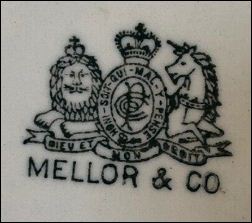 CPCo Mellor & Co |
|
James Carr Use of part of British Royal Coat of Arms with the Lion, Unicorn and the Royal Mottos - with letters "JC" in the Shield. |
Fell & Thropp Company Fell & Thropp operated the old Taylor & Speeler pottery, known as the Trenton Pottery. Use of part of British Royal Coat of Arms with the Lion, Unicorn. |
Mellor and Company In 1894 the Cook Pottery Co. were successors of Ott & Brewer at the Etruria Pottery - some of the Mellor marks had the name 'ETRURIA' Use of the British Royal Coat of Arms with the Lion, Unicorn and Royal mottos. The monogram of the Cook Pottery Company in the centre. |
|
|
|
|
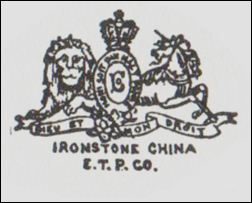 Ironstone China E E.T.O. Co |
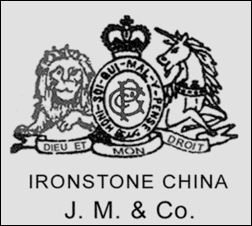 GP Ironstone China J. M. & Co |
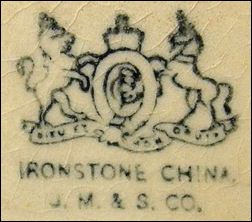 GP Ironstone China J. M. & S. Co |
|
East Trenton Pottery Co In 1888 they were producing ware using a mark of the Arms of the State of New Jersey. On white ironstone a variation of the British Royal Arms was used. Use of part of British Royal Coat of Arms with the Lion, Unicorn, but with letters in the Shield but both Royal mottos. |
John Moses & Co
|
|
|
|
|
|
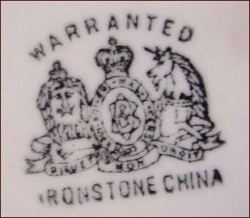 Warranted O&B Ironstone China |
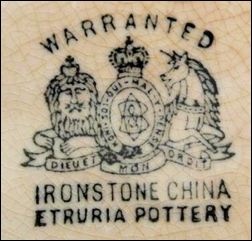 Warranted O&B Ironstone China Etruria Pottery |
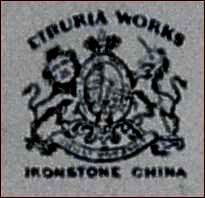 Etruria Works Ironstone China |
|
Ott & Brewer
They also used various style of the British Royal Arms. They were succeeded by The Cook Pottery Company who retained the name 'Etruria'
|
||
|
|
|
|
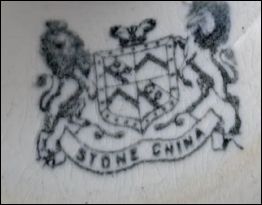 P P Co Stone China |
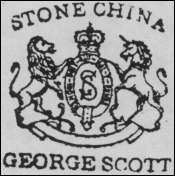 Stone China George Scott |
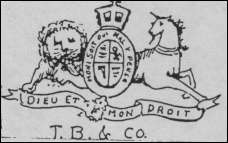 T. B. & Co |
|
Pioneer Pottery Co "In 1885, the Pioneer Pottery Co. was organized. On white granite the lion and unicorn supporting a shield was use." Use of the Lion, Unicorn of British Royal Coat of Arms. The central shield has the initials P. P. & Co |
George Scott Use of part of British Royal Coat of Arms with the Lion, Unicorn, but with letters "GS" in the Shield and only one Royal motto.
|
Tempest, Brockman & Co. Use of the full British Royal Coat of Arms with the Lion, Unicorn, Shield and both mottos.
|
|
|
|
|
|
|
often the mark has W.M.Co underneath |
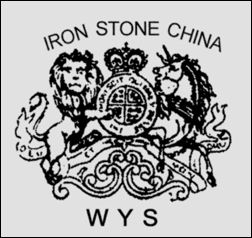 Iron Stone China W Y S |
|
Vodry & Brothers Use of part of British Royal Coat of Arms with the Lion, Unicorn, but with letters "V&B" in the Shield and no mottos. |
Willets Manufacturing
Company In 1879 the business of William Young & Sons was sold to the Willets Manufacturing Company |
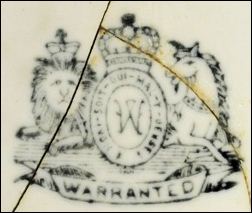
William Young & Sons From 1858 to 1879 their mark included the British Royal Coat of Arms William Young was employed by John Ridgway, of Shelton, England. He afterwards went into business for himself and subsequently emigrated to the USA. |
 see Ott & Brewer's use of the name "ETRURIA WORKS"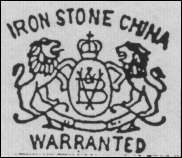
|
American Pottery Comes of Age: The Shift to National Symbols |
American potters begin to adopt national symbols
As the quality of American-made pottery improved, consumers became increasingly confident in purchasing domestic wares.
This shift was accompanied by a gradual transition away from variations of the British Royal Arms towards the use of distinctly American imagery.
Common motifs included the American eagle and elements derived from the Great Seal, such as shields bearing the Stars and Stripes, olive branches, and arrows.
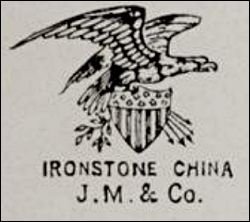
John Moses & Co combined both American and British emblems in their marks. An American eagle mark was introduced in 1876, and from around 1895 the company also employed a variety of British coat of arms designs.
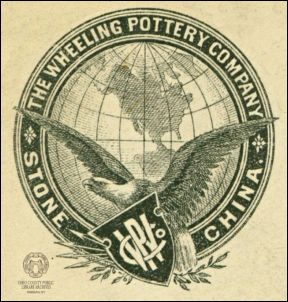
In 1879, the Wheeling Pottery Company was incorporated in West Virginia. From the outset, it adopted overtly American symbolism in its marks.
One example features a globe centred on North America, with a prominent American eagle clutching a shield bearing the monogram “WPC.”
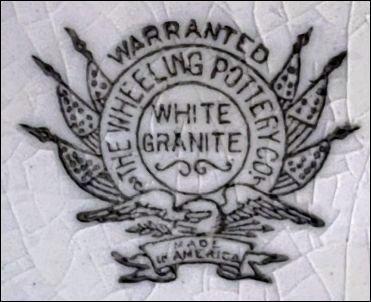
Another mark incorporates the eagle, Stars and Stripes flags, and the wording “Made in America,” likely intended to contrast with the “Made in England” found on much imported ware.
Homer Laughlin & Co were key proponents of emphasising the “Americanness” of their products. Probably in response to criticism from English potters that American manufacturers were imitating British marks,
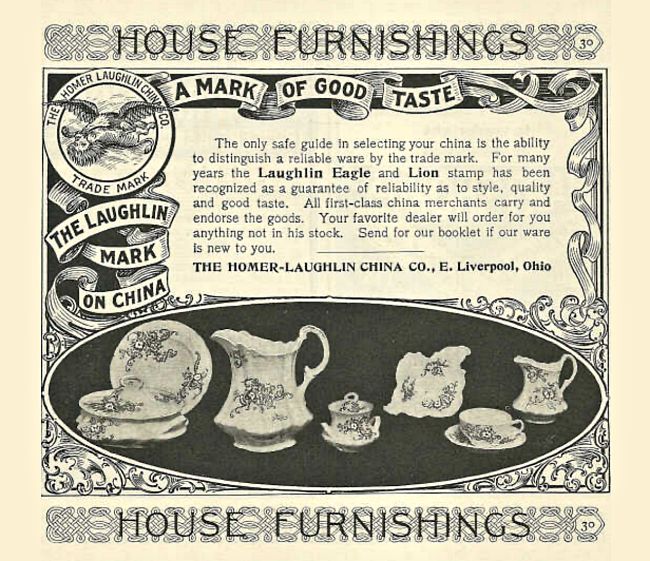
the Laughlin Brothers introduced, in the 1870s, a design depicting an American eagle attacking or dominating a supine British lion.
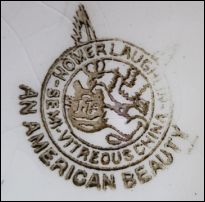
In 1898, the American Beauty shape was introduced by the Homer Laughlin China Company. The name “American Beauty” was likely chosen to reinforce the quality and desirability of domestically produced wares.
An advertisement in Home Furnishings features the Laughlin eagle-and-lion design (by now registered as a trademark) alongside the phrases “The Laughlin Mark on China” and “A Mark of Good Taste.”
John Moses & Co, Glasgow Pottery, Trenton, New Jersey - founded in 1863.
They used a variety of marks, amongst these a mark with the American eagle and stars and stripes shield was introduced in 1876 - later marks with the British Coat of Arms were used from 1895Edwin Atlee Barber, Marks of American Potters (1904), pp. 54–55.
Ironstone China
J. M. & Comark introduced in "1876 was the American eagle and shield, on white granite"
GP
(monogram)
Ironstone China
J. M. & Co"The marks of John Moses & Sons Co. are several varieties of the British Coat of Arms for white granite, used from about 1895 to the present time" [1904]
|
The Wheeling Pottery Company, West Virginia - incorporated in 1879.
|
Stone China
"WPC"
monogram representing
the Wheeling Pottery Co
Warranted
The Wheeling Pottery Co
White Granite
Made in AmericaIn 1879 the Wheeling Pottery Company was incorporated in West Virginia. Wheeling Pottery Co. Seal c.1881
Ohio County Public Library Archives
Wheeling W.VAAs well as the American Eagle this mark has stars and stripes flags and the wording "Made in America"...
... which contrasts with the "Made in England" on much imported ware - when the country of origin was required by the McKinley Tariff Act of 1890.
Laughlin Bros, Later Homer Laughlin China Company, East Liverpool, Ohio - started in 1873
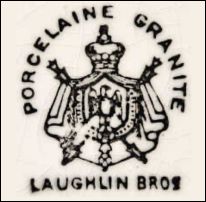
An early c. 1873-77 mark by Laughlin Bros, features a shield and the term “Porcelaine Granite”, closely echoing the French-style branding already used by some English potteries. This led to disputes and accusations of imitation from the English.The Laughlin Brothers hit back with a mark showing the "American Eagle" attacking or dominating the supine "British Lion"
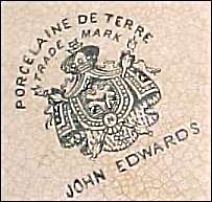
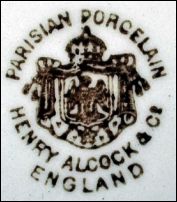
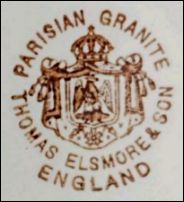
English potters use of 'Parisian' / 'Porcelaine' Laughlin use of 'Porcelaine' Marks such as a French eagle alongside the words 'Parisian', 'Porcelaine' or similar were not statements of origin, but marketing devices used by English potters in the 19th century. They were intended to suggest a fashionable French association, as French ceramics were widely regarded as stylish and desirable.
In reality, the ware was typically manufactured in England—usually in Staffordshire—these marks reflect the competitive export trade, where continental-sounding branding helped English manufacturers appeal to both domestic and overseas markets.An early c. 1873-77 mark by Laughlin Bros, features a shield and the term “Porcelaine Granite”, closely echoing the French-style branding already used by some English potteries. This led to disputes and accusations of imitation from the English.
Porcelaine De Terre
John Edwards
Parisian Porcelain
Henry Alcock & Co
Parisian Granite
Thomas Elsmore & Son
Porcelaine Granite
Laughlin Bros
There is an evident irony in the dispute, as English manufacturers objected to Laughlin’s use of French-style shield marks and the term “Porcelaine Granite”, despite having already adopted very similar branding themselves.
In fact, Staffordshire potteries had long used continental-sounding names such as “Parisian Granite” alongside heraldic devices and pseudo-European emblems, all intended to enhance the perceived refinement of their wares.
Rather than a clear case of copying, the controversy reflects a wider 19th-century pattern in which British, French, and American manufacturers freely borrowed stylistic and commercial conventions from one another in an intensely competitive international market.
Homer Laughlin and the Rise of American White Granite Ware
After serving in the Civil War, Homer Laughlin entered business in Pittsburgh in 1865, first as a retailer and briefly in oil development before turning to the pottery trade. By the late 1860s he was dealing in East Liverpool and other American wares, distributing them widely across the Midwest.
In 1870 he moved to New York with his brother Shakespeare Laughlin, where they began importing and wholesaling English pottery. This experience proved decisive: at the time, the American market was still dominated by British ceramics.
In 1873 the brothers founded Laughlin Bros., becoming pioneers in the domestic production of white ironstone china. This marked a turning point in the U.S. pottery industry, challenging the long-standing dominance of English manufacturers. By 1877 Homer Laughlin had bought out his brother and established what became the Homer Laughlin China Company, eventually operating one of the largest pottery works in the world.
Laughlin’s wares quickly achieved international competitiveness. At the 1876 Centennial Exposition in Philadelphia, his firm won a medal and diploma for the “best white granite wares,” placing American ceramics in direct rivalry with British imports.
The company’s success led to accusations from English manufacturers that its wares imitated British trademarks. In response, Laughlin adopted a deliberately distinctive mark—an eagle attacking a supine lion—symbolically asserting an American identity in contrast to English tradition.
His achievements were further recognised with major awards, including a gold medal at the Cincinnati Exposition (the first such award for pottery in the United States) and the only gold medal for ceramics—covering both plain and decorated white granite ware—at the 1893 Columbian Exposition in Chicago.
Source: The National Cyclopaedia of American Biography, Vol. XVI (New York: James T. White & Company, 1918), p. 251.
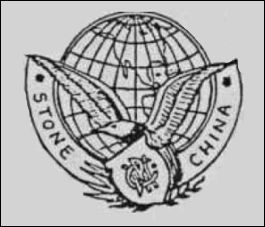
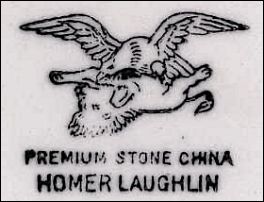
Premier Stone China In the 1870s the Laughlin Brothers introduced this mark showing the "American Eagle" attacking or dominating the supine "British Lion" |
The American Beauty shape was introduced by the Homer Laughlin China Company in 1898. probably the name 'American Beauty' was chosen to emphasise the quality of domestically produced ware. |
|
source acknowledgement: LaurelHollowPark.net |